

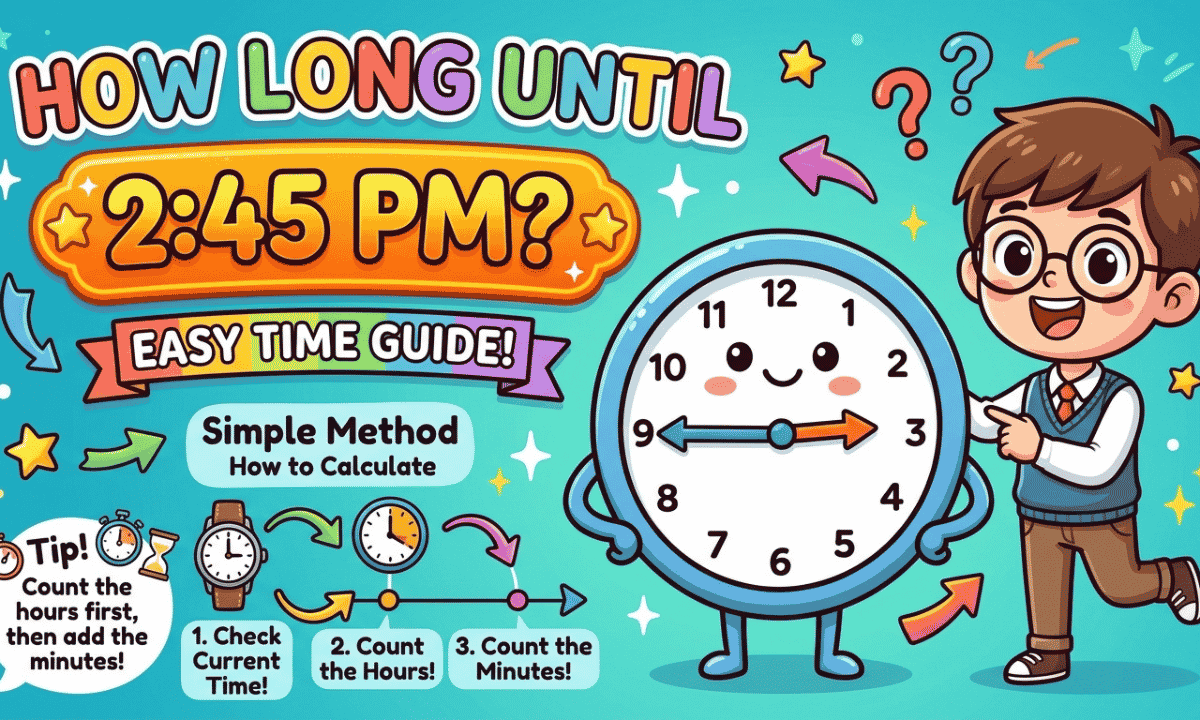
How long until 2:45 PM? It sounds like a tiny question, yet people ask it all day long. Students ask it in class. Workers ask it before meetings. Parents ask it before school pickup.
The good news is that the answer takes only seconds to find. You need the current time and a little simple math. Once you know the trick, you can repeat it for any time of day.
This guide gives you a clear method, real examples, and the mistakes to avoid. Soon, counting down to 2:45 PM will feel automatic, and your daily planning will run much more smoothly.
1. Meaning / Definition of 2:45 PM
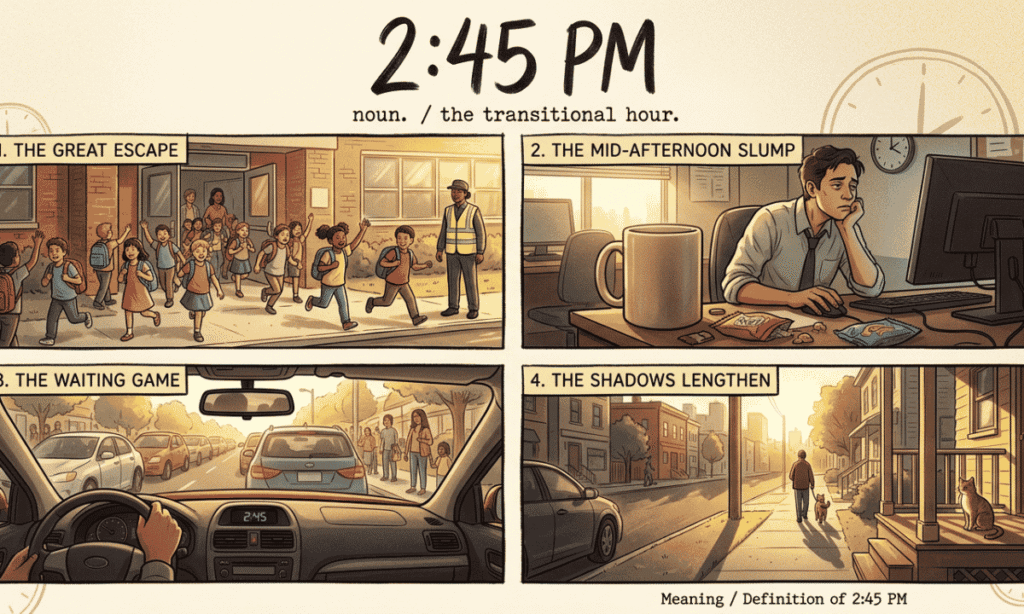
The question “how long until 2:45 PM” asks for the time left before the clock reaches 2:45 in the afternoon. It is a simple countdown from now to a fixed point.
In 24-hour format, this time is written as 14:45. Military time writes it as 1445. Many people also say “quarter to three.”
The moment sits 885 minutes after midnight. That number helps with fast math, as you will see below.
Quick Answer
Subtract the current time from 2:45 PM. The result is the time you have left.
Here is a quick reference table.
| Current Time | Time Left Until 2:45 PM |
| 9:00 AM | 5 hours 45 minutes |
| 11:00 AM | 3 hours 45 minutes |
| 12:00 PM | 2 hours 45 minutes |
| 1:00 PM | 1 hour 45 minutes |
| 1:45 PM | 1 hour |
| 2:15 PM | 30 minutes |
| 2:30 PM | 15 minutes |
2. Meaning in Simple Words
In plain words, the question means, “How much time do I still have?”
You are not measuring the whole afternoon. You are only measuring the gap between two points on the clock.
If the gap is small, you hurry. If the gap is large, you can relax. That is the whole idea.
Easy Calculation Method
Use this three-step method. You can do it in your head.
- Jump from the current time to the next full hour.
- Add the full hours until you reach 2:00 PM.
- Add the last 45 minutes.
Here is an example. Say it is 11:20 AM.
- 11:20 AM to 12:00 PM is 40 minutes.
- 12:00 PM to 2:00 PM is 2 hours.
- Add the final 45 minutes.
The total is 3 hours and 25 minutes.
Prefer a different route? Try the “3:00 minus 15” trick. First, find the time left until 3:00 PM. Then subtract 15 minutes.
From 1:10 PM, you need 1 hour 50 minutes to reach 3:00 PM. Subtract 15 and you get 1 hour 35 minutes.
There is also a minutes-from-midnight method. Convert the current time to minutes, then subtract it from 885. At 10:30 AM, that is 630 minutes. So 885 minus 630 leaves 255 minutes, or 4 hours 15 minutes.
3. Real-Life Examples
Numbers make more sense with a story. These seven examples show how the countdown works in daily life.
Example 1: Lunch Break
Your lunch break ends at 2:45 PM. It is now 1:50 PM.
Count 10 minutes to 2:00 PM. Then add 45 more. You have 55 minutes to eat, relax, and walk back to your desk.
Example 2: School Class
The final bell rings at quarter to three. It is 1:15 PM.
From 1:15 to 2:00 is 45 minutes. Add another 45 and you get 90 minutes. A student can finish a worksheet and still pack a bag before the bell.
Example 3: Work Meeting
A team call starts at 2:45 PM. It is 11:00 AM.
You have 3 hours and 45 minutes. Use that time to finish a report. Then spend the last 15 minutes preparing your notes.
Example 4: Appointment
You have a dentist visit at 2:45 PM. The clinic asks you to arrive 15 minutes early.
So your real target is 2:30 PM. If it is 12:40 PM now, you have 1 hour 50 minutes before you must be in the waiting room.
Example 5: Travel Planning
A train leaves at 2:45 PM. The drive to the station takes 40 minutes. Parking and tickets take 15 more.
Work backward. That is 55 minutes in total, so you must leave by 1:50 PM. If it is 12:30 PM, you have 1 hour 20 minutes before you need to go.
Example 6: Online Event
A webinar starts at 2:45 PM Eastern. You live in the Pacific time zone, which is three hours behind.
The event starts at 11:45 AM for you. If it is 9:30 AM where you are, you wait 2 hours 15 minutes.
Example 7: Homework Deadline
An online assignment is due at 2:45 PM. It is 9:30 AM.
You have 5 hours and 15 minutes. Split that time into two study blocks and one break. Keep the last 15 minutes for a final check and upload.
4. Synonyms and Related Terms

People search for this idea in many ways. The words change, but the goal stays the same. They all ask for the gap between now and a set time.
You may see phrases such as:
- time left until 2:45 PM
- how many minutes until 2:45
- hours and minutes remaining
- minutes until quarter to three
- time until 14:45
Related Time Keywords
These terms often appear next to the main question. Knowing them helps you search faster and read time tools with ease.
| Term | Simple Meaning |
| Countdown timer | A tool that ticks down to a set time |
| Time remaining | The gap that is still left |
| Time difference | The gap between two clock times or two zones |
| Elapsed time | Time that has already passed |
| Time interval | The span between two moments |
| 14:45 | The 24-hour form of the time |
| Military time | A 24-hour style, written as 1445 |
| Time zone converter | A tool that matches clocks across regions |
| Alarm or reminder | An alert that warns you before a set time |
| Quarter to three | The spoken form of the same moment |
5. When to Use
A quick countdown helps in many daily moments. Here are the best situations for using the 2:45 PM countdown.
For Appointments
Doctors, dentists, and salons run on tight slots. A countdown tells you when to leave home.
Always subtract the early arrival time too. That small step saves you from a stressful rush.
For School
Students use countdowns to pace tests, labs, and study sessions. A clear gap reduces stress before the last bell.
It also helps teachers plan how much of a lesson fits before dismissal.
For Work
Meetings, calls, and deadlines often land in the afternoon. A countdown to 2:45 PM keeps your tasks in order.
It also stops you from starting a big job too close to a meeting.
For Travel
Flights, trains, and buses leave at fixed times. Count backward to find your leave time.
Then add a buffer for traffic, security lines, and delays.
For Cooking
Recipes need exact timing. If a dish must reach the table by quarter to three, subtract the cooking and resting time.
The result is your start time. This works well for roasts, baking, and slow cooking.
For Exercise
Gym classes and training sessions start on schedule. Work out how long you have left.
Then plan time to change clothes, warm up, and drink water.
For Online Meetings
Remote calls often involve more than one time zone. Check the gap before you join.
Test your link and audio five minutes early. That keeps you calm and on time.
For Daily Planning
A countdown turns a vague afternoon into clear blocks. Split the time into tasks, breaks, and buffers.
You will feel more in control, and your to-do list will shrink faster.
6. When NOT to Use
This simple method has limits. In some cases, you should skip it or adjust it first.
When You Do Not Know the Current Time
No starting point means no answer. Check a phone, watch, or wall clock first.
A wrong clock gives a wrong result. Make sure your device shows the right time.
When the Time Zone Is Different
If the event follows another region’s clock, convert it first. Then subtract.
Skip this step and you could be off by several hours.
When 2:45 PM Has Already Passed
If it is 4:00 PM, that moment is behind you. You are now measuring time since, not time until.
If you want the next one, count toward tomorrow afternoon. That adds a full day to your math.
When the Date Is Important
Some events are not today. A meeting next Friday needs days, not only hours.
Always include the date in your calculation. A clock alone cannot show it.
When Daylight Saving Time Matters
When clocks move forward or back, one night has 23 or 25 hours. A countdown across that change may be off by one hour.
In that case, use a trusted calendar or time tool. Do not rely on mental math alone.
Read More How Long Until 330 Pm
7. Common Mistakes
Even simple math goes wrong when you rush. Watch out for these seven errors.
Mistake 1: Forgetting AM and PM
2:45 AM and 2:45 PM are 12 hours apart. Mixing them up creates a huge error.
Always read the label. It is the smallest part of the time, but it matters most.
Mistake 2: Subtracting the Hours but Ignoring Minutes
Some people subtract only the hour numbers. From 11:50 AM, they say the gap is 3 hours.
The real gap is 2 hours 55 minutes. Minutes always count.
Mistake 3: Forgetting the Next Day
Once 2:45 PM passes, the next one comes tomorrow. At 3:30 PM, the wait is 23 hours 15 minutes.
Do not assume the answer is negative or zero. Add a day instead.
Mistake 4: Using the Wrong Time Zone
Your phone shows local time. An invite may use another zone.
Read the zone label every time. A single missed letter, like ET or PT, can change your plan.
Mistake 5: Rounding Too Early
Rounding 12:50 up to 1:00 hides 10 minutes. That is enough to miss a bus.
Do the full math first. Round only at the very end.
Mistake 6: Confusing 24-Hour and 12-Hour Time
In 24-hour format, 14:45 is the same as 2:45 PM. Some people misread it as 4:45.
Subtract 12 from any hour above 12. That simple rule fixes the confusion.
Mistake 7: Forgetting That Time Changes
Math done at 10:00 AM is outdated by 10:30. The clock keeps moving.
Recheck as the event nears. A fresh look prevents last-minute surprises.
8. Comparison with Similar Terms

Many people mix up time formats and similar phrases. A quick comparison clears things up.
12-Hour vs. 24-Hour Format
Both formats show the same moment. They only differ in style.
| Feature | 12-Hour Format | 24-Hour Format |
| Example | 2:45 PM | 14:45 |
| Uses AM/PM | Yes | No |
| Common in | US, Canada, Pakistan (daily use) | Military, aviation, much of Europe |
| Midnight | 12:00 AM | 00:00 |
| Noon | 12:00 PM | 12:00 |
| Afternoon hours | 1:00 PM to 5:59 PM | 13:00 to 17:59 |
The 24-hour style leaves less room for error. The 12-hour style feels more natural in speech.
Example Countdown Table
This table compares the wait for three nearby times. It shows why a small shift in the target changes your plan.
| Current Time | Until 2:30 PM | Until 2:45 PM | Until 3:00 PM |
| 1:00 PM | 1 hour 30 min | 1 hour 45 min | 2 hours |
| 1:30 PM | 1 hour | 1 hour 15 min | 1 hour 30 min |
| 2:00 PM | 30 min | 45 min | 1 hour |
| 2:15 PM | 15 min | 30 min | 45 min |
| 2:30 PM | Now | 15 min | 30 min |
Read More How Long Until 230 Pm Today
Conclusion
How long until 2:45 PM? The answer is always the same simple step. Subtract the current time from the target and keep AM and PM in mind.
Use the jump-to-the-hour method for quick mental math. Use the minutes-from-midnight method when you want extra accuracy.
Watch for time zones, dates, and daylight saving shifts. They are the main reasons people get it wrong.
With a little practice, counting down to 2:45 PM becomes second nature. You will arrive on time, finish tasks sooner, and enjoy a calmer day.
Frequently Asked Questions
How long until 2:45 PM?
It depends on your current time. Subtract the current time from 2:45 PM to get the exact hours and minutes.
What is 2:45 PM in 24-hour time?
It is 14:45. Military time writes it as 1445.
How many minutes after midnight is 2:45 PM?
It is 885 minutes after midnight. This helps with quick subtraction.
What is the easiest way to calculate the time left?
Jump to the next full hour, add the whole hours, then add 45 minutes. This works in your head.
Does the time zone change the answer?
Yes. Convert the event time to your local time first, then subtract.
What if the time has already passed today?
Count toward tomorrow instead. Add 24 hours to the target time, then subtract the current time.
Does daylight saving time affect the countdown?
Yes, if your countdown crosses a clock change. The gap can shift by one hour.
Can I set an alarm for this time?
Yes. Set a phone alarm or reminder a few minutes early. That gives you a safe buffer.