

What time was it 6 hours ago? It sounds like a small question, but it comes up all the time.
You may want to know when you fell asleep. Maybe you need to trace when a message arrived. Or you are checking a delay at work.
The fix is simple. Subtract six hours from the current time and watch out for midnight. This guide shows you how to find the exact time 6 hours ago, with examples, tables, and handy tools.
What Time Was It 6 Hours Ago?
To find the time 6 hours ago, take your current time and subtract six hours. That is the whole rule.
Say it is 3:00 PM now. Six hours earlier was 9:00 AM. Say it is 10:30 AM. Six hours earlier was 4:30 AM.
The minutes stay the same. Only the hour changes. Here is a quick reference chart.
| Current Time | Time 6 Hours Earlier |
| 6:00 AM | 12:00 AM (midnight) |
| 9:00 AM | 3:00 AM |
| 12:00 PM | 6:00 AM |
| 3:00 PM | 9:00 AM |
| 6:00 PM | 12:00 PM (noon) |
| 9:00 PM | 3:00 PM |
| 12:00 AM | 6:00 PM (previous day) |
| 3:00 AM | 9:00 PM (previous day) |
Bookmark this table. It covers most everyday cases.
How Does Time Calculation Work?
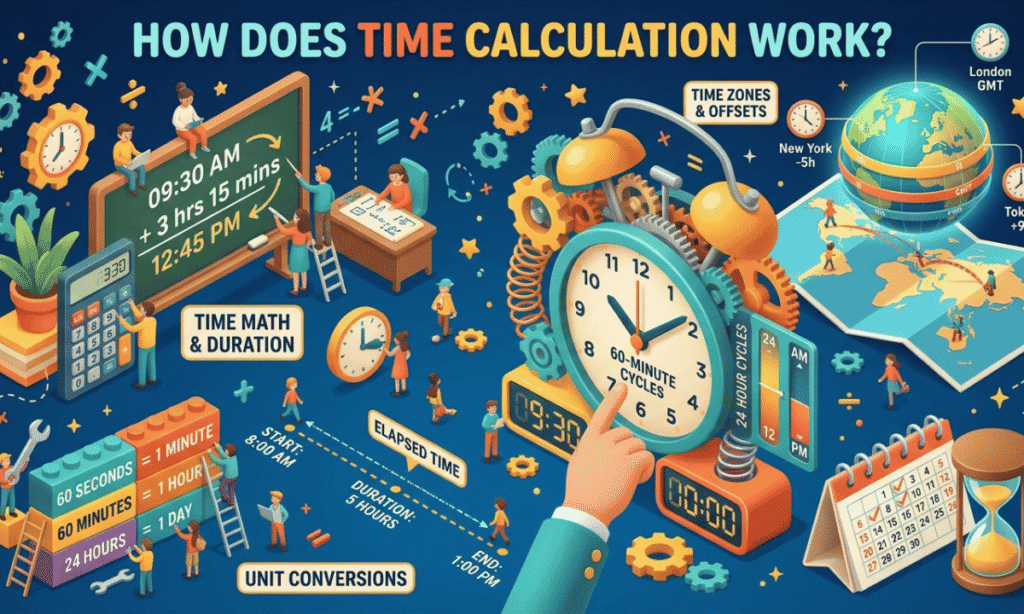
A day has 24 hours. A clock repeats that cycle every day. So going back in time means moving backward around the same loop.
Most people use a 12-hour clock with AM and PM. Others use a 24-hour clock, which runs from 00:00 to 23:59. The math is the same in both.
Follow these steps:
- Write down the current time.
- Subtract 6 from the hour.
- If the result is zero or negative, add 12 (or 24 on a 24-hour clock).
- Switch AM to PM, or PM to AM, if you crossed noon or midnight.
- Check whether the date moved back by one day.
That is all there is to elapsed time math. Once you try it a few times, it becomes automatic.
What Time Was It 6 Hours Ago in GMT+5?
GMT+5 means a place runs five hours ahead of Greenwich Mean Time. Pakistan Standard Time follows this offset. So do a few other regions.
The method does not change. Subtract six hours from your local time. There is no extra step for the offset.
If it is 8:00 PM in GMT+5, then 6 hours ago it was 2:00 PM in GMT+5. In GMT, that same moment was 9:00 AM.
| Local Time (GMT+5) | 6 Hours Earlier (GMT+5) | Same Moment in GMT |
| 8:00 PM | 2:00 PM | 9:00 AM |
| 1:00 PM | 7:00 AM | 2:00 AM |
| 4:00 AM | 10:00 PM (previous day) | 5:00 PM (previous day) |
Pakistan does not use daylight saving time at present. That keeps the offset steady all year. You can still confirm it on a trusted time zone site if rules change.
Manual Time Calculation Is Easier Than Most People Think
Many people reach for a phone right away. You often do not need to. A quick mental trick works well.
Here is one. Subtract 12, then add 6. Going back six hours is the same as going back twelve hours and then forward six.
Another trick is to use the clock face. Six hours is exactly half the dial. Look at the opposite side of the clock. The hour directly across from 4 is 10. The hour across from 9 is 3.
Try it a few times. You will start to see the pattern. The opposite number on the clock is always six hours away.
Examples of Reverse Time Calculation
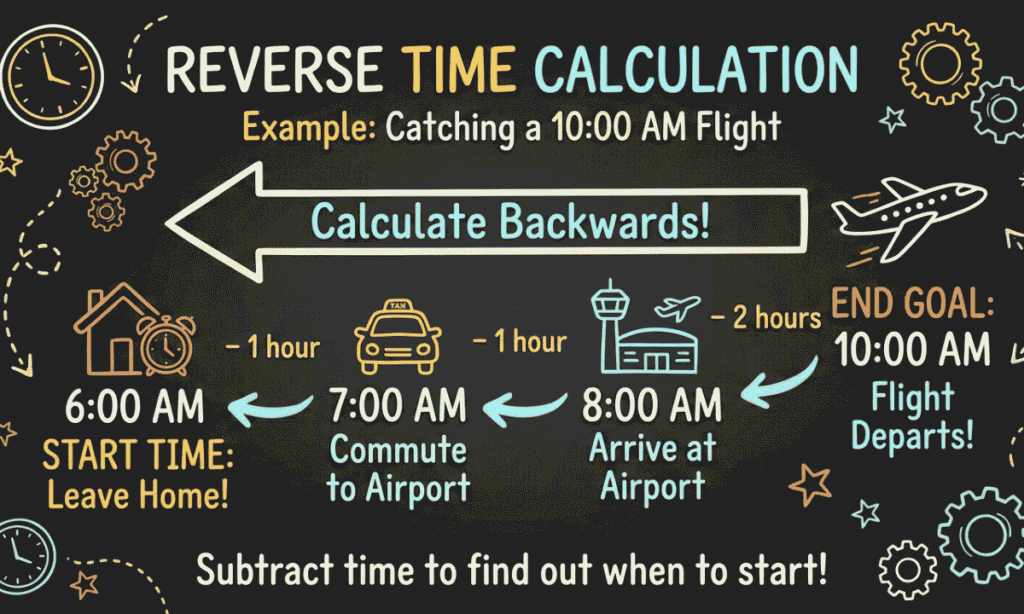
Examples make the process clear. Here are four common times of day.
Morning Example
It is 8:15 AM. Subtract six hours.
8 minus 6 is 2. So the answer is 2:15 AM.
You did not cross midnight. The date stays the same.
Afternoon Example
It is 2:40 PM. Subtract six hours.
2 minus 6 is negative 4. Add 12 to get 8. The time becomes 8:40 AM.
The AM and PM label flipped. That is the part people often miss.
Evening Example
It is 7:05 PM. Subtract six hours.
7 minus 6 is 1. So the answer is 1:05 PM.
Both times are in the same day. No date change is needed.
Night Example
It is 1:30 AM. Subtract six hours.
1 minus 6 is negative 5. Add 12 to get 7. The result is 7:30 PM.
This time you crossed midnight. So the answer belongs to the previous day. If today is Friday, the answer is Thursday at 7:30 PM.
Why People Search “What Time Was It 6 Hours Ago”
People type this question for many reasons. Most of them are practical. Few are just curious.
Some want to check a log or timestamp. Others want to verify a delivery, a call, or a post. Some simply lost track of the day.
Here is why the search is so common:
- It is a quick fact check.
- Mental math feels risky near midnight.
- Time zones add confusion.
- People want an exact answer, not a guess.
If you ever wondered what time was it 6 hours ago, you are in good company. It is one of the most common reverse time questions online.
Common Situations Where You Need to Calculate Six Hours Earlier
Let us look at real cases. You may recognize a few of them.
Sleep Tracking
You wake up at 6:00 AM and feel groggy. When did you actually fall asleep? If you slept six hours, you went to bed at midnight.
Sleep apps use the same math. Knowing 6 hours ago helps you spot short nights. It also helps you plan a better bedtime.
Work Shifts
Shift workers often count backward. A nurse who ends at 7:00 AM started at 1:00 AM on a six-hour shift.
Payroll teams use this too. They match clock-in and clock-out times. A small slip can change a pay record.
Flight Planning
Travelers cross time zones often. A six-hour gap is common between regions. Say you land at 4:00 PM. Your body clock may still sit at 10:00 AM.
Calculating the earlier time helps you plan meals, rest, and meetings. It also helps with jet lag.
Cooking
Some recipes need long waits. Slow-cooked meat, brined food, and dough all work on timers.
If a roast has cooked since noon, it has six hours at 6:00 PM. Subtracting time tells you when the food went in. That helps with food safety too.
Event History
Journalists and researchers build timelines. They need to know when something happened relative to now.
A post says “six hours ago.” You subtract six hours from the current time. Now you have an approximate timestamp.
Digital Tools That Calculate Previous Time
You do not have to do it by hand. Many free tools do the work in seconds.
Common options include:
- Online time calculators. Type a time, choose “subtract hours,” and get the result.
- Smartphone clocks. Many phones show world clocks and time differences.
- Search engines. A query like “time 6 hours ago” often shows a direct answer.
- Spreadsheet formulas. In Excel or Google Sheets, subtract 6/24 from a time value.
- Programming functions. Most languages can subtract hours from a date object.
These tools are fast and accurate. They also adjust for the date. Still, check that your device clock and time zone are correct. A wrong setting gives a wrong answer.
Understanding AM, PM, and 24-Hour Time
AM means before noon. PM means after noon. Midnight is 12:00 AM. Noon is 12:00 PM.
Those two special cases cause most mistakes. People think 12 AM is noon. It is not.
The 24-hour clock avoids this problem. It has no AM or PM. Here is how the two systems compare.
| 12-Hour Clock | 24-Hour Clock |
| 12:00 AM | 00:00 |
| 6:00 AM | 06:00 |
| 12:00 PM | 12:00 |
| 6:00 PM | 18:00 |
| 11:00 PM | 23:00 |
On a 24-hour clock, finding 6 hours ago is easy. Just subtract six. At 15:00, the answer is 09:00. At 04:00, add 24 first. So 28 minus 6 is 22, and the answer is 22:00 the day before.
Human Perception of Time Is Surprisingly Strange
Six hours can feel very different depending on what you were doing. A long flight feels slow. A fun day feels short.
Researchers have studied this for years. Our sense of time stretches and shrinks. Attention, stress, and boredom all play a role.
That is why people misjudge elapsed time. You might think a call was an hour ago. It may have been four. Memory is not a clock.
This is one more reason to check the real time. When you ask what time was it 6 hours ago, a quick calculation beats a guess every time.
Time Zones Can Make Things Look More Complicated Than They Really Are
Time zones confuse many people. Yet the idea is simple. Each zone is just an offset from UTC.
When you subtract six hours, you stay inside one zone. The offset does not matter. You only need it when you compare two places.
Keep these points in mind:
- Subtracting hours is the same in every zone.
- Converting between zones is a separate step.
- Daylight saving time can shift a local clock by one hour.
Daylight saving is the real trap. If the clocks changed in the last six hours, the answer may be off by one hour. In that case, use a tool that knows the local rules.
Crossing Midnight Changes the Date
Midnight is the most common source of errors. When you go back past 12:00 AM, the date moves back too.
Let us say it is Monday, 2:00 AM. Subtract six hours. The result is 8:00 PM on Sunday.
Many people get the time right but the day wrong. That small mistake can ruin a report or a schedule.
Here is a simple check. If the current hour is 1 to 5 (AM or on a 24-hour clock), the answer falls on the previous day. For hour 6 exactly, the answer is midnight, which is the start of the same day.
The same logic works across month and year changes. At 3:00 AM on January 1, 6 hours ago was 9:00 PM on December 31.
Manual Clock Calculation vs Online Calculators
Both methods work. Each has strengths. Pick the one that fits your need.
| Feature | Manual Calculation | Online Calculator |
| Speed | Fast for simple cases | Instant for all cases |
| Accuracy | Good, if careful | Very high |
| Handles dates | Needs extra care | Automatic |
| Handles time zones | Difficult | Built in |
| Needs internet | No | Usually yes |
For quick checks, do the math in your head. For records, legal timestamps, or time zone work, use a tool.
A good habit is to do both. Calculate it yourself, then confirm with a calculator. You will learn the pattern faster that way.
Common Mistakes People Make
Most errors are small. They are also easy to avoid once you know them.
Forgetting Midnight
People subtract and stop at zero. At 2:00 AM, 2 minus 6 is negative 4. You must wrap around the clock. The correct answer is 8:00 PM.
Mixing Up AM and PM
After wrapping, the label flips. A time like 3:00 PM minus six hours becomes 9:00 AM. Forgetting the flip gives 9:00 PM, which is wrong.
Ignoring the Date
The time may be right while the day is wrong. Always check whether you crossed midnight. If so, go back one calendar day.
Subtracting From the Wrong Hour
Some people subtract from the minutes by accident. Others use the wrong starting time. Always start from the exact current time. Then subtract only the hours.
Confusing “Ago” With “From Now”
“Ago” means the past. “From now” means the future. If you add six hours instead, you get the wrong direction. When you want 6 hours ago, always subtract.
Why Reverse Time Calculation Matters
Going backward in time may seem like a niche skill. In reality, it supports many daily tasks.
Productivity Tracking
Time trackers log when work began. Subtracting hours shows how long a task has run. This helps you see where your day went.
Appointment Calculation
Late for a meeting? You can check when it was supposed to start. You can also check how long ago a call was missed.
Reminder History
Reminders and alerts often show relative time. Subtracting hours helps you find the exact moment a reminder fired.
Sleep Analysis
Sleep depends on timing. Counting back from your wake time shows your real sleep length. It also shows if your schedule is consistent.
Digital Activity Logs
Servers, apps, and devices keep logs. Developers and IT teams read them all day. They subtract hours to trace errors and track events. Accurate math keeps those timelines clean.
Real Life Examples
Here are a few simple stories.
The late-night message. Sam sees a text at 11:20 PM. It says it was sent 6 hours ago. So it arrived at 5:20 PM. Sam realizes he missed it during dinner.
The server alert. An engineer sees an error at 2:10 AM. She wants to know what changed six hours earlier. That was 8:10 PM the day before. She finds a software update at that time.
The traveler. Aisha lands at 9:00 AM. She wants to know when she left the airport hotel. If the trip took six hours, she left at 3:00 AM. That explains her tired eyes.
The baker. Leo started his dough at 7:30 AM. It is now 1:30 PM. Six hours have passed, and it is ready.
Each story uses the same simple math. Only the context changes.
Understanding Relative Time
Relative time describes a moment compared to now. Phrases like “6 hours ago,” “yesterday,” or “last week” are all relative.
Social media, news sites, and apps use it everywhere. It feels natural and friendly. But it is not exact.
“6 hours ago” can mean anything from 5.5 to 6.5 hours. Apps often round the number. For precise work, always find the full timestamp.
Relative time also depends on your device clock. If your clock is off, the label is off too. So keep your device set to automatic time.
Read More How Long Until 330 Pm
Conclusion
Finding the time 6 hours ago is easy once you know the steps. Subtract six from the hour. Flip AM and PM when needed. Check the date if you cross midnight.
For fast results, use the tables in this guide. For tricky cases, use a trusted online tool. Pay extra attention to time zones and daylight saving changes.
Next time you ask what time was it 6 hours ago, you will know exactly how to answer. A few seconds of care gives you a clear, correct time.
Frequently Asked Questions
What time was it 6 hours ago?
Subtract six hours from your current time. If it is 5:00 PM now, then 6 hours ago it was 11:00 AM.
How do I calculate 6 hours ago manually?
Subtract 6 from the hour and keep the minutes the same. If the number drops below 1, add 12 and switch AM or PM.
What time was it 6 hours ago in GMT+5?
Use the same method with your GMT+5 local time. At 9:00 PM, 6 hours ago was 3:00 PM.
Does 6 hours ago change the date?
Yes, if you cross midnight. For example, 3:00 AM minus six hours is 9:00 PM the day before.
Is there a trick to find six hours earlier?
Look at the opposite side of the clock face. That number is always six hours away.
Does daylight saving time affect the answer?
It can. If clocks changed during the six hours, the real difference may shift by one hour.
What is the 24-hour format for 6 hours ago?
Subtract six from the hour. For 14:00, the answer is 08:00. For 03:00, add 24 first to get 21:00 the day before.
Which tools can find the time 6 hours ago?
Online time calculators, phone world clocks, and spreadsheet formulas all work. Search engines can also show a quick answer.