

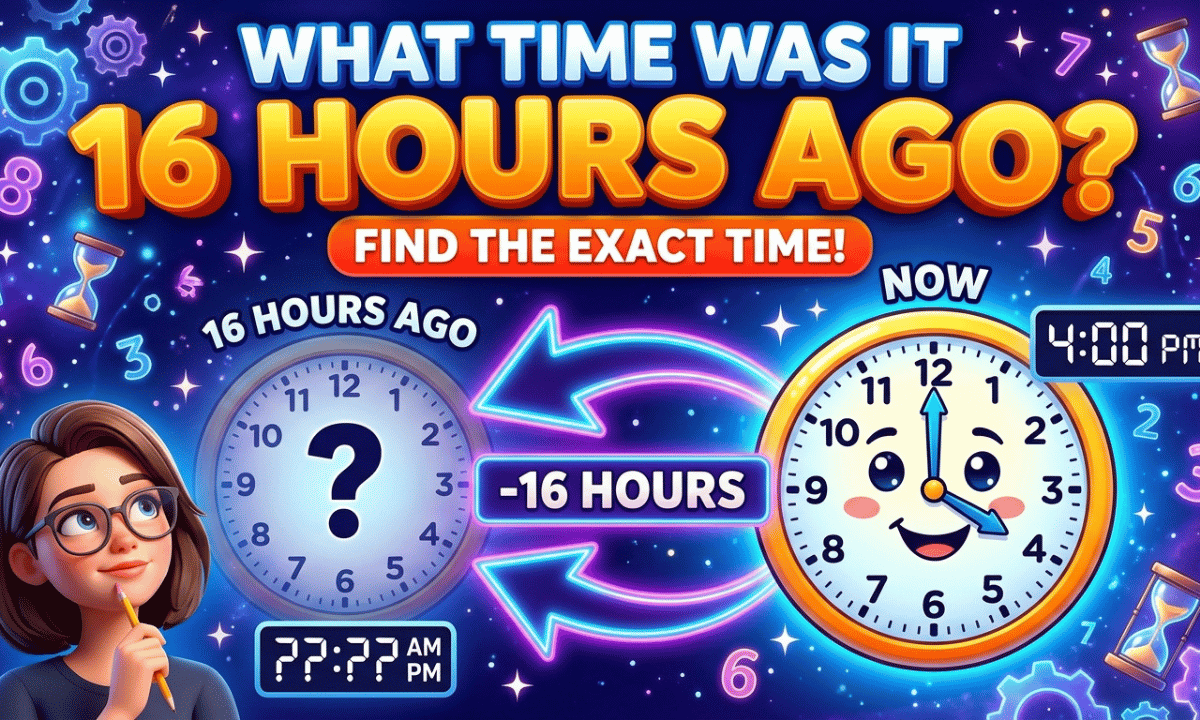
16 hours ago can feel like a blur when you are checking a message, a shift, or a meal against the clock. You know roughly when it happened. You just need the exact time.
The good news is that the math is simple. Subtract 16 hours from the current time, and watch out for midnight.
This guide shows you how to find the time 16 hours ago in seconds. You will get easy methods, clear examples, and practical tips for accurate answers.
Why Do People Search “What Time Was It 16 Hours Ago”?
People search this phrase for very practical reasons. They want a quick, reliable answer without opening a calculator.
Sometimes the reason is work. A manager may need to confirm when a shift began. A nurse may need to check when a medicine was given.
Sometimes the reason is personal. You might wonder when you last slept, ate, or sent a text.
Here are the most common reasons:
- Checking when a message or email was sent
- Confirming the start of a work shift
- Tracking sleep and wake-up times
- Verifying meeting times across regions
- Reviewing logs, receipts, or security records
A 16-hour gap is long enough to cross into a different day. That is exactly why people get confused and look for a clear answer.
How to Calculate 16 Hours Ago
The core idea is easy. Take your current time and move backward by 16 hours.
Here is the simplest method, step by step:
- Write down the current time.
- Convert it to 24-hour format if you can.
- Subtract 16 from the hour.
- Keep the minutes the same.
- If the result is negative, add 24 to it.
- If you added 24, the answer falls on the previous day.
For example, say it is 14:30 now. Subtract 16 from 14. You get negative 2. Add 24, and you get 22. So 16 hours ago was 22:30 yesterday, or 10:30 PM.
Minutes never change when you subtract whole hours. Only the hour and the date shift.
A Faster Mental Shortcut
There is an even quicker trick. Going back 16 hours is the same as going forward 8 hours and then stepping back one day.
If it is 5:00 PM now, add 8 hours to get 1:00 AM. Then move that to the previous day. So 16 hours ago was 1:00 AM, earlier today.
Wait, that sounds off, so let us check it. Going forward 8 from 5:00 PM gives 1:00 AM tomorrow. Stepping back one full day lands on 1:00 AM today. That is correct.
Understanding Clock Arithmetic
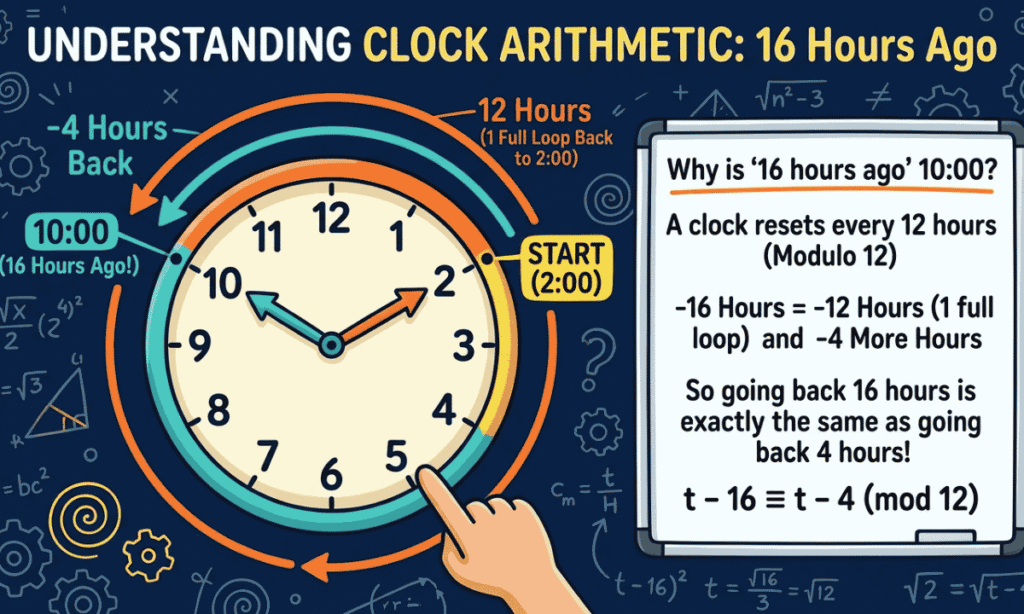
Clock math works differently from ordinary math. A clock repeats. After 12 comes 1 again on a 12-hour dial. After 24 comes 0 on a 24 hour clock.
Mathematicians call this modular arithmetic. You do not need to learn the theory. You only need one rule.
The rule: if your answer drops below zero, add 24.
Think of the clock as a circle. Moving back 16 hours means walking 16 steps around that circle. Sometimes you pass the top, which is midnight, and the date changes.
Here are a few quick conversions:
- 16 hours equals 960 minutes
- 16 hours equals 57,600 seconds
- 16 hours equals two-thirds of a full day
That last point is a helpful anchor. Because 16 is two-thirds of 24, the time 16 hours ago is usually on the previous day or very early today.
Crossing the Midnight Boundary
Midnight is where most mistakes happen. The clock resets, but the calendar date also changes.
The rule is simple. If subtracting 16 gives a negative number, you crossed midnight. Your answer belongs to yesterday.
If the subtraction gives zero or a positive number, you stayed on the same day.
Here is a quick way to check, using the current hour in 24-hour time:
| Current Hour (24-hour) | Result After Subtracting 16 | Day of the Answer |
| 00:00 to 15:59 | Negative number | Previous day |
| 16:00 to 23:59 | Zero or positive | Same day |
So if it is 4:00 PM or later, 16 hours ago was today. If it is before 4:00 PM, 16 hours ago was yesterday.
This small rule answers many questions at once. It also helps you decide whether to write “yesterday” or “today” in your notes.
12-Hour Clock System vs 24-Hour Time
Most people read time in the 12-hour system with AM and PM. Many industries use the 24-hour clock, also called military time.
The 24-hour format makes subtraction much easier. There is no AM or PM to track. You just subtract and, if needed, add 24.
Here is a side-by-side comparison:
| Feature | 12-Hour Clock | 24-Hour Clock |
| Format | 1:00 AM to 12:00 PM | 00:00 to 23:59 |
| AM/PM needed | Yes | No |
| Ease of subtraction | Moderate | Easy |
| Common use | Daily life, phones | Aviation, hospitals, military |
| Risk of mix-ups | Higher | Lower |
If you prefer the 12-hour clock, try this. Subtract 12 hours first, which flips AM to PM or the reverse. Then subtract the remaining 4 hours.
For example, start at 9:00 AM. Subtract 12 hours to get 9:00 PM yesterday. Subtract 4 more hours to get 5:00 PM yesterday.
What Happens Inside a Time Difference Calculator?

A time difference calculator does the same steps you do, only faster. It reads your current time and converts it into a single number.
Many systems store time as a count of seconds. This is often called a timestamp. The calculator subtracts 57,600 seconds, which equals 16 hours.
Then it converts the new number back into a readable date and time.
Here is what happens behind the screen:
- The tool reads your device clock.
- It converts the time to a numeric timestamp.
- It subtracts 16 hours worth of seconds.
- It adjusts for your time zone.
- It displays the result as a date and time.
This is why digital tools rarely make midnight errors. They never “forget” to change the date.
Most also handle daylight saving time automatically. That is a big advantage over mental math.
Local Time and Time Zones Matter More Than You Think
Your answer is only correct if you use the right time zone. The same moment has a different clock reading in every region.
Suppose you are chatting with a friend in another country. Your “16 hours ago” and their “16 hours ago” show different clock times. The moment is the same, but the local readings differ.
That is why you should always confirm which time zone you need.
Keep these points in mind:
- Use your local time for personal questions
- Use the sender’s time zone for message checks
- Use UTC for server logs and technical records
- Remember that some regions use half-hour offsets
The Daylight Saving Time Trap
Daylight saving time can quietly break your math. On the day clocks change, a day has 23 or 25 hours.
If 16 hours ago falls across that change, a simple subtraction can be off by one hour. A digital tool handles this for you.
For manual checks, look at the date of the clock change before you trust your answer.
Real Life Examples of Calculating 16 Hours Ago
Examples make the method easy to remember. Here are five common cases.
The table below gives a quick view first.
| Current Time | 24-Hour Math | Time 16 Hours Ago | Day |
| 8:00 PM | 20:00 − 16 = 04:00 | 4:00 AM | Today |
| 10:00 AM | 10:00 − 16 = −6, so 18:00 | 6:00 PM | Yesterday |
| 3:30 PM | 15:30 − 16 = −0:30, so 23:30 | 11:30 PM | Yesterday |
| 7:45 AM | 07:45 − 16 = −8:15, so 15:45 | 3:45 PM | Yesterday |
| 11:20 PM | 23:20 − 16 = 07:20 | 7:20 AM | Today |
Example 1: Current Time Is 8:00 PM
Convert 8:00 PM to 20:00. Subtract 16 hours, and you get 04:00.
The result is positive, so you stayed on the same day. The answer is 4:00 AM today.
Example 2: Current Time Is 10:00 AM
The 24-hour time is 10:00. Subtracting 16 gives negative 6.
Add 24, and you get 18:00. That means 6:00 PM yesterday.
Example 3: Current Time Is 3:30 PM
Convert to 15:30. Subtract 16 hours, and you land at negative 0:30.
That means 30 minutes before midnight. The answer is 11:30 PM yesterday.
This case surprises people. It is only 30 minutes short of staying on the same day.
Example 4: Current Time Is 7:45 AM
Start with 07:45. Subtract 16 hours to reach negative 8:15.
Add 24 hours, and you get 15:45. So the answer is 3:45 PM yesterday.
Example 5: Current Time Is 11:20 PM
Convert to 23:20. Subtract 16 hours, and you get 07:20.
That is a positive result. The answer is 7:20 AM today.
Why Human Memory Doesn’t Work Like a Clock

Your brain does not store events with timestamps. It stores moments, feelings, and context.
When someone asks what you did 16 hours ago, you rarely recall a clock reading. You recall a scene, such as dinner, a commute, or a phone call.
That is why estimates often drift. Memory compresses busy hours and stretches quiet ones.
Researchers in cognitive psychology describe this as reconstructive memory. You rebuild the past each time you recall it.
So a calculation gives you something memory cannot. It gives you a fixed anchor point.
Timeline Reconstruction in Everyday Life
Timeline reconstruction means rebuilding the order of events. People do it all the time without noticing.
Imagine you feel unwell and want to recall what you ate. You work backward from now. Starting from the exact time 16 hours ago can help you place each meal.
Here is a simple way to build a timeline:
- Note the current time.
- Calculate the time 16 hours ago.
- List what you remember between those two points.
- Mark any gaps.
- Check your phone, receipts, or messages to fill them.
This method works for sleep logs, travel days, and work reports. It turns a vague memory into a clear sequence.
The Psychology Behind Time Perception
Time does not feel equal. A boring hour drags, while a fun hour flies.
Psychologists call this subjective time. Attention, emotion, and routine all change how long a period feels.
Sixteen hours is a special case. It is roughly a full waking day for many adults. It also covers a night of sleep.
Because sleep skips conscious awareness, the gap feels shorter than it is. You wake up and think, “It was only a moment ago.”
This is why people often misjudge when something happened 16 hours ago. A quick calculation removes the guesswork.
Technology Makes Time Calculations Effortless
You no longer need paper or a calculator. Almost every device can do this for you.
Here are the easiest options:
- Search engines: Type your question and get an instant result
- Phone clock apps: Many include a world clock and a timer
- Voice assistants: Ask for the time 16 hours back
- Online calculators: Enter a time and subtract hours
- Spreadsheets: Use a simple formula to subtract hours from a timestamp
In a spreadsheet, you can subtract 16 divided by 24 from a date-time cell. This works because the sheet counts one day as the number 1.
These tools save time and reduce human error. They also adjust for time zones and daylight saving changes.
Read More How Long Until 240 Pm
Common Situations Where You Need to Calculate 16 Hours Ago
This calculation is useful in many areas of life. Here are the most common ones.
Work Schedules
Shift work often runs long. Overtime, double shifts, and on-call duty can stretch past 12 hours.
If you clock out now, 16 hours ago tells you when your day started. Managers use this to verify hours and rest breaks.
Some industries also have rules on maximum duty time. A quick check keeps you on the safe side.
Sleep Tracking
Most adults stay awake about 16 hours a day. That makes this number a handy benchmark.
If you go to bed at 11:00 PM, then 16 hours ago was 7:00 AM. That is likely when you woke up.
Tracking this helps you see if your routine is steady.
Social Messaging
Messaging apps show times like “sent 16 hours ago.” That label is useful, but it is vague.
Calculating the exact time helps you tell whether a message arrived last night or this morning. It also helps when people live in different time zones.
Meeting Time Verification
Teams across countries often mix up meeting times. A short check prevents missed calls.
Work backward from the current time to confirm when an invite was sent. Then compare it to the meeting time in each region.
This habit avoids awkward no-shows and rescheduling.
Security and Digital Records
Logs, login alerts, and receipts all carry timestamps. Many are stored in UTC.
If you see a suspicious login, you may want to know if it happened 16 hours ago. Convert the log time to your local time first.
Then subtract the hours. This gives you a clear picture of the event.
For important security reviews, always rely on the original timestamp. Do not trust labels like “yesterday” alone.
Manual Calculation vs Digital Tools
Both methods work. The right choice depends on your need.
| Factor | Manual Calculation | Digital Tool |
| Speed | Moderate | Instant |
| Accuracy | Good with care | Very high |
| Time zone support | Limited | Built in |
| Daylight saving handling | Easy to miss | Automatic |
| Works offline | Yes | Sometimes |
| Best for | Quick estimates | Records and legal checks |
Manual math is great for a fast estimate. It also keeps your mind sharp.
Digital tools win when accuracy matters. Use them for work logs, travel, and security.
Practical Tips for Accurate Time Calculations
A few habits will keep your answers correct.
- Use 24-hour time. It removes AM and PM confusion.
- Check the date. Always note if the answer is today or yesterday.
- Confirm the time zone. Decide which region you are working in.
- Watch for clock changes. Daylight saving days can shift the answer by an hour.
- Keep minutes unchanged. Only the hour changes when you subtract whole hours.
- Double-check near midnight. Times close to 12:00 AM cause the most errors.
- Verify with a tool. Use a calculator for anything important.
Here is one more memory trick. Remember “minus 12, then minus 4.” It splits the task into two easy steps.
With practice, you will answer these questions almost instantly.
Why Understanding Time Matters

Time is the quiet structure behind every plan. Work, travel, health, and relationships all depend on it.
When you can calculate time gaps with confidence, you make fewer mistakes. You also communicate more clearly.
Saying “around 3:45 PM yesterday” is far better than saying “sometime yesterday.” It builds trust in reports, chats, and records.
Small skills like this save real minutes and real stress. They also make you more aware of how your day flows.
Conclusion
Finding the time 16 hours ago is simple once you know the rule. Subtract 16 from the current hour, keep the minutes, and add 24 if the answer drops below zero.
Remember the midnight rule. If it is before 4:00 PM now, the answer lands on yesterday. If it is 4:00 PM or later, the answer is today.
Use manual math for quick checks. Use digital tools for time zones, daylight saving, and important records. With these steps, you can answer “what time was it 16 hours ago” in seconds.
Frequently Asked Questions
What does 16 hours ago mean?
It means the exact moment that occurred 16 hours before the current time. You find it by moving 16 hours back on the clock.
How many minutes are 16 hours?
Sixteen hours equal 960 minutes. Multiply 16 by 60 to get this number.
How many seconds are 16 hours?
Sixteen hours equal 57,600 seconds. Multiply 960 minutes by 60.
Can 16 hours ago be yesterday?
Yes. If the current time is before 4:00 PM, the time 16 hours ago falls on the previous day.
How do I calculate 16 hours ago mentally?
Subtract 12 hours first, then subtract 4 more. Or add 8 hours and move back one day.
Does the exact answer depend on my current time?
Yes. The result changes every minute because it is always measured from the present moment.
Does the time zone affect the calculation?
Yes. Each region shows a different clock reading for the same moment, so always use the correct time zone.
Is 16 hours ago always the previous day?
No. It is the previous day only before 4:00 PM. From 4:00 PM onward, it is the same day.
Is 16 hours the same as 960 minutes?
Yes. Sixteen hours multiplied by 60 minutes equals exactly 960 minutes.