

15 hours ago sounds like a simple question until you try to answer it at 2 a.m. Do you subtract 15, add 9, or flip AM and PM? Many people pause for a moment.
This guide gives you the answer fast. You will learn the exact method, a quick mental trick, and real examples. You will also see how time zones change the result, especially for readers in Pakistan.
By the end, you can work out what time it was 15 hours ago in seconds. No calculator. No confusion.
What Does “15 Hours Ago” Actually Mean?
The phrase 15 hours ago points to a moment in the past. It is exactly 15 hours before the current time.
That is 900 minutes. It is also 54,000 seconds.
The tricky part is the date. Fifteen hours is more than half a day. So the answer often lands on the previous calendar day.
Here is a quick snapshot:
- It is the elapsed time between a past event and right now.
- It always counts in full hours, not in clock faces.
- It can cross midnight, which changes the date.
- It depends on your local time zone.
That last point matters a lot. We will return to it later.
How to Calculate 15 Hours Ago Manually
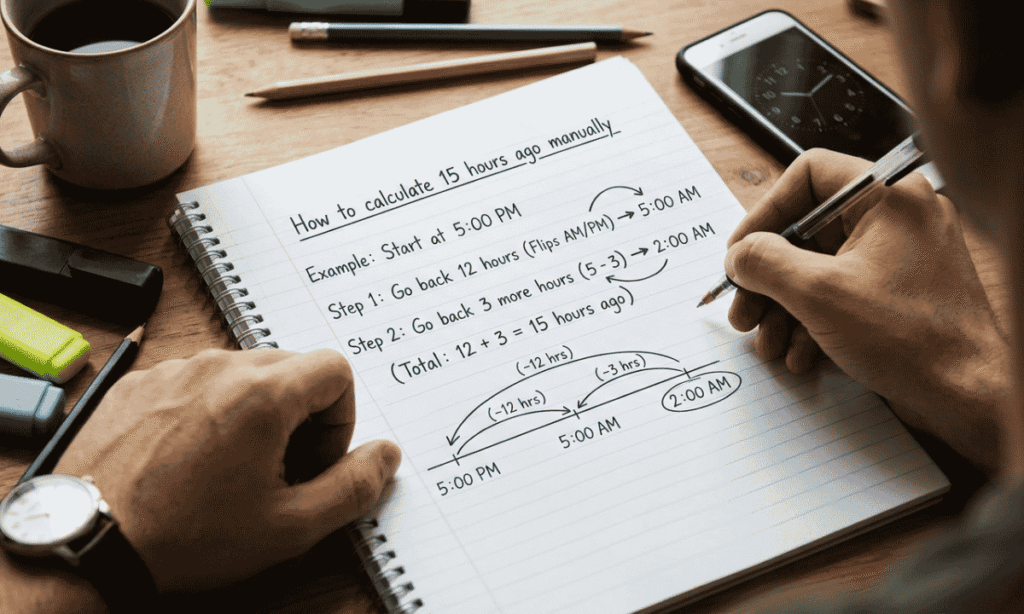
You do not need an app. You only need simple subtraction. Here is the easiest method.
- Write down the current time.
- Subtract 12 hours. This flips AM to PM, or PM to AM.
- Subtract 3 more hours.
- Check whether you crossed midnight. If yes, use the previous date.
That is all. Fifteen is just twelve plus three.
Let us test it. Say the time is 10:00 AM.
- Subtract 12 hours: 10:00 PM (yesterday).
- Subtract 3 more hours: 7:00 PM (yesterday).
So 15 hours ago was 7:00 PM the previous day.
The Add 9 Shortcut
There is another trick. A full day has 24 hours. So going back 15 hours equals going forward 9 hours and then stepping back one day.
From 10:00 AM, add 9 hours. You get 7:00 PM. Then use yesterday’s date. Same answer.
What Time Was It 15 Hours Ago in Pakistan?
Pakistan uses Pakistan Standard Time, or PKT. It runs at UTC+5. The country does not use daylight saving time right now, so the offset stays steady all year.
That makes calculations easier. The gap never shifts in spring or autumn.
If you live in Lahore, Karachi, Islamabad, or Faisalabad, use your local clock. Then subtract 15 hours using the steps above.
Here is a handy PKT table.
| Current time in Pakistan | Time 15 hours ago | Day |
| 12:00 AM | 9:00 AM | Previous day |
| 6:00 AM | 3:00 PM | Previous day |
| 12:00 PM | 9:00 PM | Previous day |
| 3:00 PM | 12:00 AM | Same day |
| 6:00 PM | 3:00 AM | Same day |
| 9:00 PM | 6:00 AM | Same day |
Notice the pattern. Evening times land in the early morning of the same day. Morning times land in the evening of the day before.
Understanding Time Zones and Why They Matter
A clock reading means little without a location. The same moment shows different times around the world.
Time zones are based on the offset from Coordinated Universal Time, or UTC. Pakistan is five hours ahead of UTC. London is level with UTC in winter. New York is five hours behind in standard time.
So your answer depends on where you stand.
The table below shows what the local clock read 15 hours ago, if it is 3:00 PM in Pakistan right now.
| Location | Offset from UTC | Local time 15 hours ago |
| Pakistan (PKT) | UTC+5 | 12:00 AM today |
| India (IST) | UTC+5:30 | 12:30 AM today |
| Dubai (GST) | UTC+4 | 11:00 PM yesterday |
| London (winter) | UTC+0 | 7:00 PM yesterday |
| New York (standard) | UTC−5 | 2:00 PM yesterday |
| Tokyo (JST) | UTC+9 | 4:00 AM today |
Daylight saving time adds one more layer. Some regions move their clocks by an hour. That can shift the answer by 60 minutes.
If an event crossed a clock change, be careful. The real elapsed time may not match the simple clock math.
The Mathematics Behind 15 Hours
Time on a clock is cyclic. After 24 hours, it repeats. That is why a little modular arithmetic helps.
The formula is simple:
Time 15 hours ago = (current hour − 15) mod 24
If the result is negative, add 24. Then move the date back one day.
Let us try it with a 24-hour clock. Suppose it is 14:00.
- 14 − 15 = −1
- −1 + 24 = 23
- The answer is 23:00 on the previous day.
Now try 20:00.
- 20 − 15 = 5
- The answer is 05:00 on the same day.
Here are some useful conversions:
| Unit | Value for 15 hours |
| Minutes | 900 |
| Seconds | 54,000 |
| Fraction of a day | 0.625 |
| Percent of a day | 62.5% |
So 15 hours ago covers a little more than five eighths of a full day. That is why the date often changes.
What Time Was It 15 Hours Ago? Real Examples
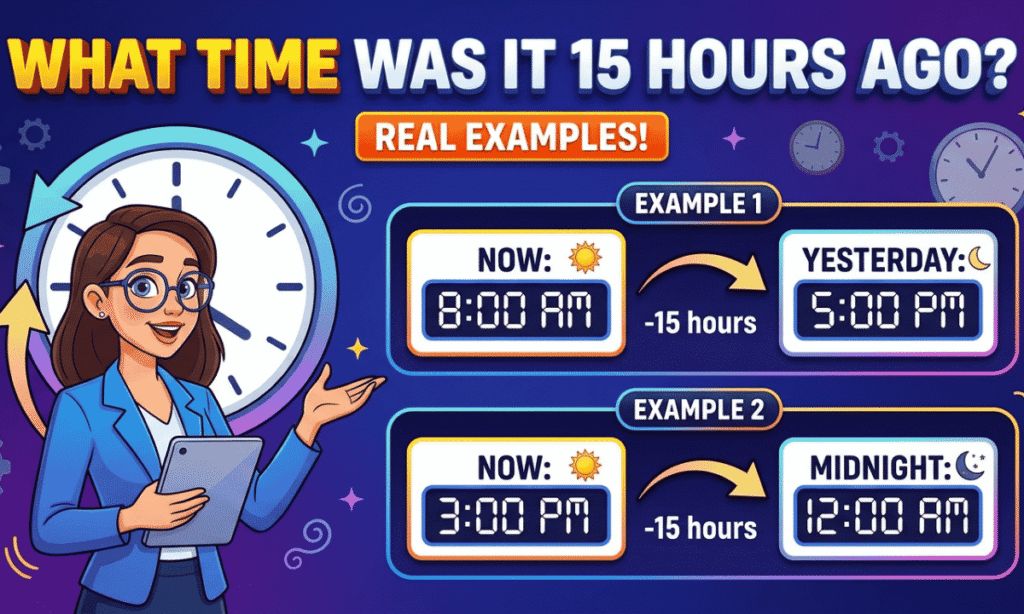
Theory is useful. Examples make it stick. Here are five real cases.
Example One
The current time is 9:00 AM.
Subtract 12 hours to get 9:00 PM. Subtract 3 more to get 6:00 PM.
Answer: 6:00 PM on the previous day.
Example Two
The current time is 3:30 PM.
Subtract 12 hours to get 3:30 AM. Subtract 3 more to get 12:30 AM.
Answer: 12:30 AM on the same day. Midnight has just passed.
Example Three
The current time is 11:45 PM.
Subtract 12 hours to get 11:45 AM. Subtract 3 more to get 8:45 AM.
Answer: 8:45 AM on the same day.
Example Four
The current time is 12:00 AM, which is midnight.
Subtract 12 hours to get 12:00 PM, a day earlier. Subtract 3 more to get 9:00 AM.
Answer: 9:00 AM on the previous day.
Example Five
The current time is 6:20 AM.
Subtract 12 hours to get 6:20 PM, a day earlier. Subtract 3 more to get 3:20 PM.
Answer: 3:20 PM on the previous day.
When Was 15 Hours Ago From Now?

This is the most common version of the question. People want the exact moment, counted back from this second.
Here is how to find it in three steps.
- Look at your device clock right now.
- Subtract 15 hours using the method above.
- Confirm the date, not just the time.
Let us say it is Saturday at 4:00 PM. Subtract 12 hours to get 4:00 AM Saturday. Subtract 3 more to get 1:00 AM Saturday.
So 15 hours ago was 1:00 AM on Saturday.
Now say it is Saturday at 8:00 AM. The same steps give 5:00 PM on Friday. The date moved back.
Always check the day. It is the step people skip most often.
Tools That Can Help You Calculate 15 Hours Ago
Manual math is great for quick answers. Tools help when accuracy matters.
Here are the most useful options:
- Online time calculators. Enter a time and an offset. The tool shows the result instantly.
- World clock apps. These compare several time zones side by side.
- Smartphone clock apps. Most phones include a world clock feature.
- Spreadsheets. In Excel or Google Sheets, type =NOW()-15/24. It returns the exact moment 15 hours back.
- Programming languages. In Python, use datetime.now() – timedelta(hours=15).
Spreadsheets and code are handy for log files. They handle dates and daylight saving changes for you.
For everyday use, a phone clock is enough. For work in IT or finance, use a tool that supports UTC.
Read More How Long Until 245 Pm
What Time Was It 15 Hours Ago and Why Do People Ask?
This question has many real uses. It is not just trivia.
Here are the common reasons:
- Tracking messages. Someone says they sent an email 15 hours ago. You want to know when.
- Checking sleep. If you woke up now, 15 hours ago may be when you were awake.
- Reading logs. Servers and apps store timestamps. Support teams need to trace events.
- Monitoring medicine. Some schedules depend on how long ago a dose was taken. Always follow a doctor’s advice for that.
- Shipping and delivery. Customers check when a parcel last updated.
- Remote work. Teams across time zones need shared reference points.
- Social media. Posts show “15 hours ago” instead of an exact time.
That last one is very common. Platforms prefer relative time because it feels natural.
Still, relative time hides the real clock reading. That is why people search for a calculator.
The Human Side of Time: Memory and Perception
Humans do not feel time like a stopwatch. A short wait can feel long. A busy day can vanish.
Fifteen hours is an odd length. It is too long to remember in detail. Yet it is short enough to still matter.
Think about what you were doing 15 hours ago. For many people, it was either last night or yesterday afternoon. The memory feels close, yet blurry.
Sleep plays a role too. If you slept through part of that window, your sense of elapsed time shrinks. Your brain simply skips the hours.
That is why people double-check with a clock. Our gut feeling is not always right.
A simple habit helps. Note the time when something important happens. A quick timestamp saves a lot of guessing later.
What Was 15 Hours Ago Across Different Parts of the Day?
A good way to learn the pattern is to look at the day in four parts. Each part has a predictable answer.
Morning
Morning runs from about 6:00 AM to 11:59 AM.
Fifteen hours earlier falls between 3:00 PM and 8:59 PM on the previous day. In plain words, it was the afternoon or early evening yesterday.
Example: at 8:00 AM, the answer is 5:00 PM yesterday.
Afternoon
Afternoon runs from about 12:00 PM to 5:59 PM.
Fifteen hours earlier falls between 9:00 PM yesterday and 2:59 AM today. Early afternoon times land in the previous night. Later ones land after midnight.
Example: at 2:00 PM, the answer is 11:00 PM yesterday.
Evening
Evening runs from about 6:00 PM to 9:59 PM.
Fifteen hours earlier falls between 3:00 AM and 6:59 AM on the same day. It was the quiet pre-dawn or early morning.
Example: at 7:00 PM, the answer is 4:00 AM today.
Night
Night runs from about 10:00 PM to 5:59 AM.
Fifteen hours earlier falls between 7:00 AM and 2:59 PM. For late-night times, it is the same day. For after-midnight times, it is the previous day.
Example: at 11:00 PM, the answer is 8:00 AM today.
Common Mistakes When Calculating 15 Hours Ago
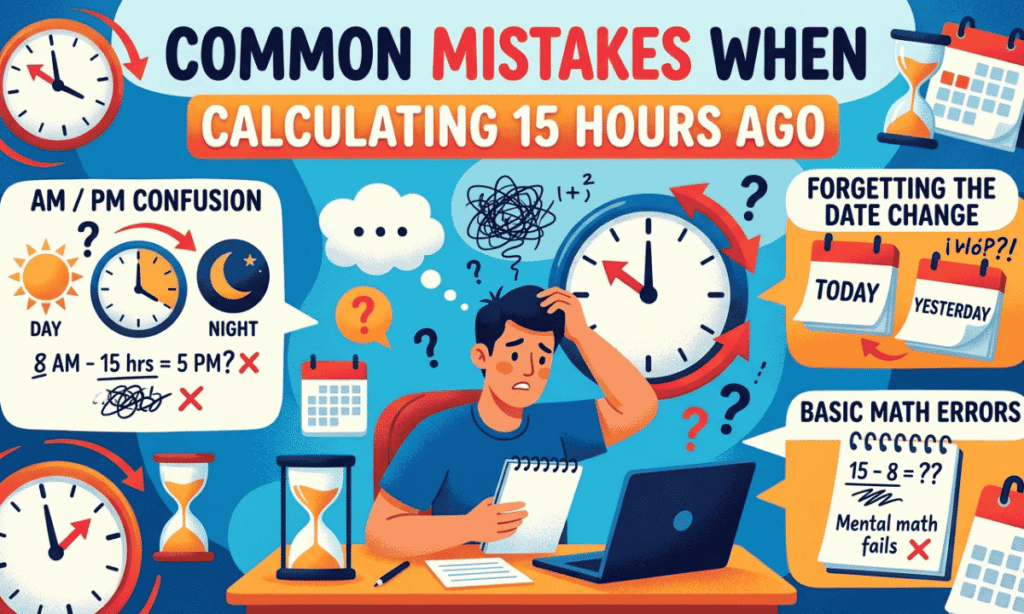
Even simple math can go wrong. Watch out for these slips.
- Forgetting the date change. The time may be right, but the day is wrong.
- Mixing up AM and PM. Flipping the wrong way gives a 12-hour error.
- Subtracting 15 from the minutes. Only the hour part changes. Minutes stay the same.
- Ignoring time zones. A server log in UTC will not match your local clock.
- Skipping daylight saving. A clock change can add or remove one hour.
- Confusing 12:00 AM and 12:00 PM. Midnight is AM. Noon is PM.
- Using a 12-hour clock with negative numbers. Convert to 24-hour time first when in doubt.
A quick tip: write the 24-hour version beside the 12-hour one. It prevents most errors.
How to Quickly Calculate 15 Hours Ago in Your Head
You can learn this in under a minute. Use this three-step trick.
- Flip AM and PM. That removes 12 hours.
- Go back 3 hours. Count backward on the clock face.
- Check midnight. If you crossed it, use yesterday.
Try it at 5:15 PM. Flip to 5:15 AM. Go back 3 hours to 2:15 AM. You did not cross midnight, so the answer is 2:15 AM today.
Here is a second trick. Think of it as “minus a day, plus nine.” Add 9 hours, then step back one day.
At 5:15 PM, add 9 hours to get 2:15 AM. That lands on the next day, so it cancels out. The answer is again 2:15 AM today.
With practice, the answer pops up almost instantly. A few tries, and you will not need a tool.
Read More How Long Until 240 Pm
Conclusion
Finding the time 15 hours ago is easy once you know the pattern. Subtract 12 hours, subtract 3 more, and check the date.
Remember the key points. Pakistan runs on UTC+5 with no daylight saving. Time zones and clock changes can shift the answer. And morning times always point to the previous afternoon or evening.
Use a phone clock, spreadsheet, or online calculator when accuracy matters. For daily life, your own quick math is enough.
Bookmark this guide and come back whenever you need to work out 15 hours ago in a hurry.
Frequently Asked Questions
What time was it 15 hours ago?
Subtract 12 hours from the current time, then subtract 3 more. If you cross midnight, use the previous date.
How many minutes are in 15 hours?
There are 900 minutes in 15 hours. That equals 54,000 seconds.
What was 15 hours ago if it is 10:00 AM now?
It was 7:00 PM on the previous day. Subtract 12 hours, then 3 more.
What was 15 hours ago in Pakistan if it is 6:00 PM?
It was 3:00 AM on the same day in Pakistan Standard Time.
Does daylight saving time change the answer?
Yes, it can. If a clock change happened in that window, the result may shift by one hour.
Is 15 hours ago the same as yesterday?
Not always. It is yesterday for morning times and the same day for evening times.
Why do apps show “15 hours ago” instead of the time?
Relative time feels natural and works for users in every time zone.
What is the fastest way to calculate 15 hours ago?
Flip AM and PM, go back 3 hours, and check whether you crossed midnight.