

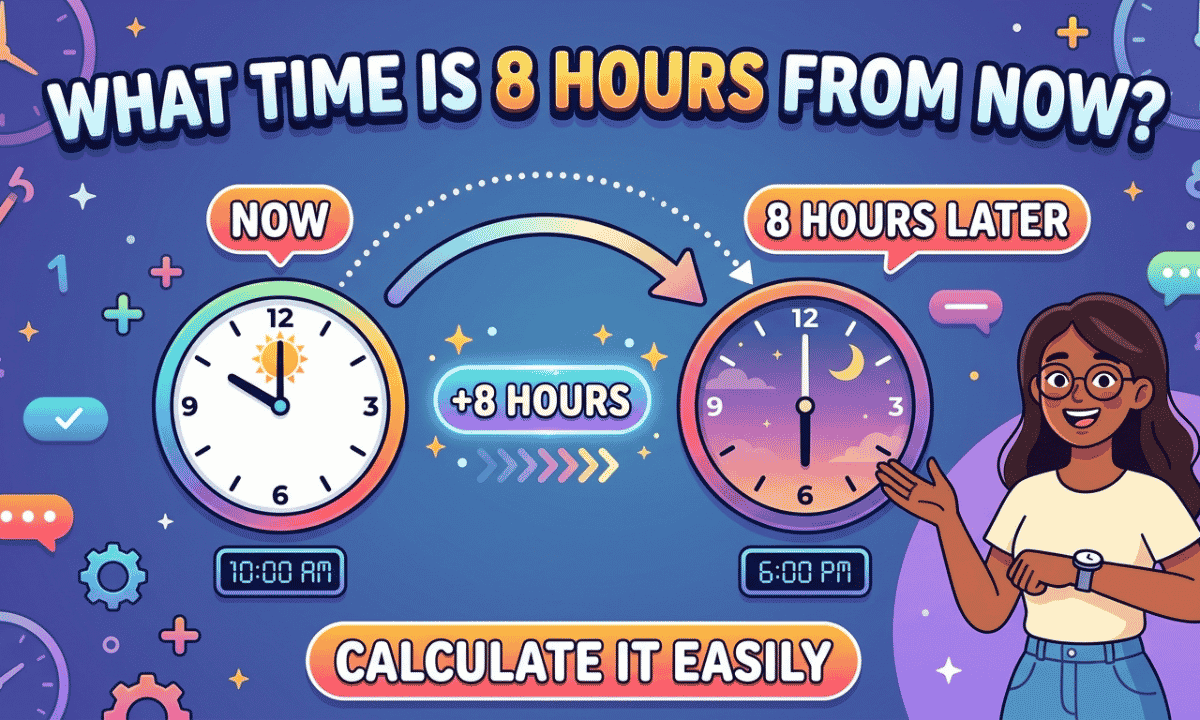
What time is 8 hours from now? It is one of the most searched time questions online, and the answer takes only seconds. Whether you are planning a shift, a flight, or a deadline, you need the right clock time. No math degree required.
The answer depends on your current time. Add eight hours, flip AM to PM when needed, and watch for midnight. Get that right, and you will never be off by an hour.
In this guide, you will learn quick shortcuts, manual steps, and common mistakes. You will also find handy tools and real examples in plain language.
What Time Is 8 Hours From Now? Quick Answer
Here is the fastest way to find the time 8 hours from now. Add eight to the current hour. If the total goes past 12, subtract 12 and switch AM to PM, or PM to AM.
Minutes never change. If it is 4:25 PM now, it will be 12:25 AM in eight hours.
Use this table as a quick reference.
| Current Time | Time After Eight Hours | Day |
| 12:00 AM | 8:00 AM | Same day |
| 3:00 AM | 11:00 AM | Same day |
| 6:00 AM | 2:00 PM | Same day |
| 9:00 AM | 5:00 PM | Same day |
| 12:00 PM | 8:00 PM | Same day |
| 3:30 PM | 11:30 PM | Same day |
| 6:00 PM | 2:00 AM | Next day |
| 9:45 PM | 5:45 AM | Next day |
| 11:00 PM | 7:00 AM | Next day |
Quick rule: if the new hour looks smaller than the starting hour, the result falls on the next day.
Understanding How Time Addition Actually Works
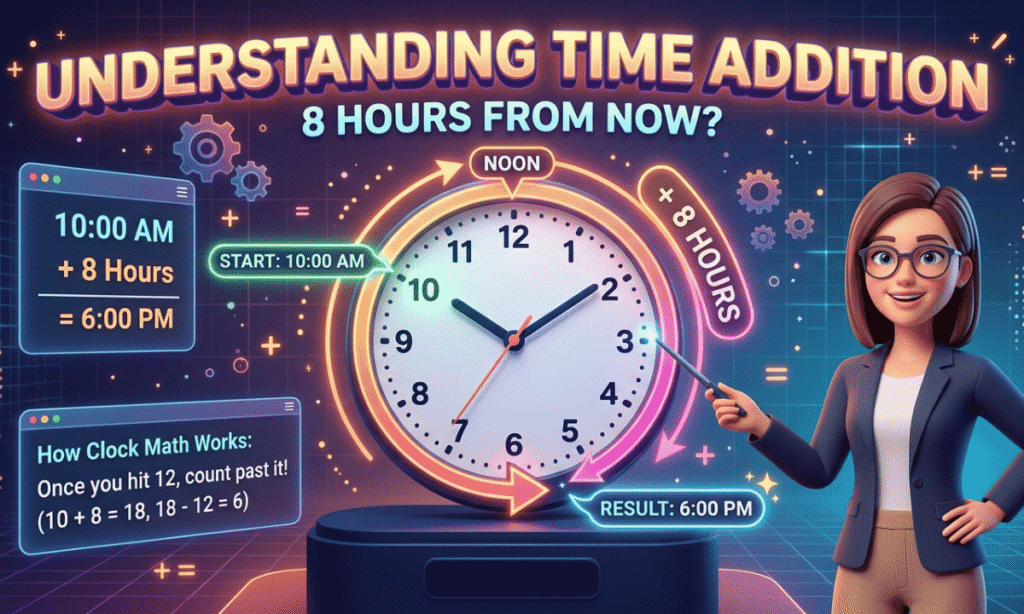
Time math feels odd because clocks are not decimal. Hours roll over at 12 or 24. Minutes roll over at 60.
Mathematicians call this clock arithmetic. When you pass the top of the clock, you simply start counting again.
Take 9:00 PM as an example. Nine plus eight equals 17. A 12-hour clock has no 17, so you subtract 12.
You get 5:00. Because you crossed midnight, it is 5:00 AM.
Adding eight hours leaves the minutes untouched. Only the hour value and the AM or PM label change.
That is the core idea. Everything else in this guide builds on it.
Why People Search “What Time Is 8 Hours From Now”
People search this phrase for practical reasons. Eight hours is a natural block of time. It matches a work day, a night of sleep, and many flights.
Others simply do not want to do mental math. A fast answer feels safer than a guess.
Common reasons include:
- Finding the end time of a work shift
- Setting a reminder or follow-up window
- Scheduling a call with someone in another country
- Estimating an arrival time on a trip
- Timing a deadline, sale, or live event
- Checking when a slow download or slow-cooker meal will finish
Many users also want a live answer. That is why hours from now calculators rank so well in search results.
What Time Is 8 Hours From Now Using the 12-Hour Clock
The 12-hour clock is common in the United States, Canada, and parts of Asia. It uses AM and PM to separate the two halves of the day.
If you want the time 8 hours from now on this clock, follow two simple rules:
- Add eight to the hour.
- If the answer passes 12, subtract 12 and flip AM or PM.
Here are a few examples:
- 7:15 AM becomes 3:15 PM
- 2:40 PM becomes 10:40 PM
- 8:30 PM becomes 4:30 AM the next day
Crossing noon flips AM to PM. Crossing midnight flips PM to AM and moves you to a new date.
The tricky part is 12 itself. Noon is 12:00 PM and midnight is 12:00 AM. Many people mix these up.
What Time Is 8 Hours From Now in the 24-Hour Clock
The 24-hour clock, often called military time, has no AM or PM. That makes the math cleaner.
On this clock, the time 8 hours from now is easy to find. Add eight. If the total reaches 24 or more, subtract 24.
Try these examples:
- 06:00 becomes 14:00
- 15:30 becomes 23:30
- 19:00 becomes 03:00 the next day
- 22:45 becomes 06:45 the next day
When the result hits 24:00, it is actually 00:00, which is midnight. Anything like 25:00 means 01:00 on the next day.
Many pilots, nurses, and engineers prefer this format. It removes the AM and PM confusion completely.
| Feature | 12-Hour Clock | 24-Hour Clock |
| Uses AM and PM | Yes | No |
| Rollover point | 12 | 24 |
| Example start | 7:00 PM | 19:00 |
| Result after eight hours | 3:00 AM | 03:00 |
Breaking Eight Hours Into Smaller Units
Sometimes you need eight hours in minutes or seconds. This is common in spreadsheets, timers, and code.
The table below shows the conversions.
| Unit | Value |
| Minutes | 480 |
| Seconds | 28,800 |
| Milliseconds | 28,800,000 |
| Days | 0.333 (one-third of a day) |
| Weeks | About 0.048 |
Eight hours also equals 16 half-hour blocks. It equals 32 quarter-hour blocks.
This helps with time tracking. If you log work in 15-minute chunks, a full shift is 32 entries.
Eight hours is exactly one-third of a 24-hour day. Many people use that split for work, rest, and personal time.
Why Time Zones Matter More Than You Think
Your answer to “what is 8 hours from now” only holds in your own time zone. Someone in another city will see a different clock time.
Suppose it is 10:00 AM in New York. Eight hours later, New York shows 6:00 PM.
In that same moment, Los Angeles shows 3:00 PM. London shows 11:00 PM. The elapsed time is identical, but the clocks disagree.
Here is what other cities would show when New York reads 6:00 PM. These are typical offsets during US daylight time.
| City | Offset From New York | Local Time |
| Los Angeles | 3 hours behind | 3:00 PM |
| London | 5 hours ahead | 11:00 PM |
| Dubai | 8 hours ahead | 2:00 AM (next day) |
| Karachi | 9 hours ahead | 3:00 AM (next day) |
| Tokyo | 13 hours ahead | 7:00 AM (next day) |
Daylight saving time adds another twist. On the day clocks change, a day can have 23 or 25 hours.
That means eight hours of real time may look like seven or nine on the wall clock. Always check the date when clocks shift.
Using a Hours From Now Calculator
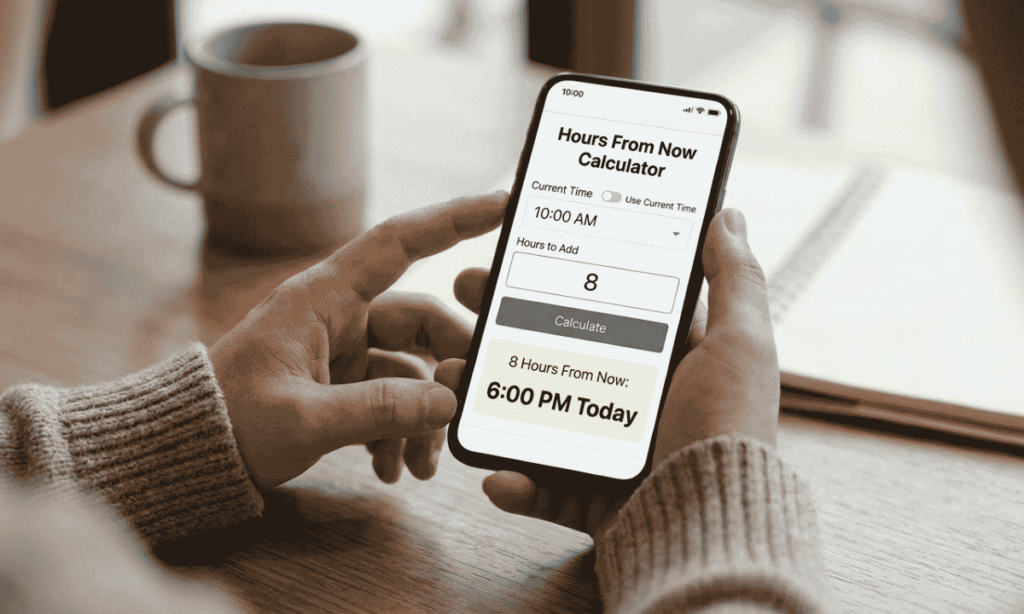
An hours from now calculator is the fastest option. It reads your device clock, adds the hours you enter, and shows the result.
To get the time 8 hours from now, you simply type 8 into the hours box. The tool does the rest.
Good calculators offer several helpful features:
- Live current time and date
- Automatic midnight and date rollover
- Support for 12-hour and 24-hour formats
- Daylight saving time adjustments
- Options to count hours backward
Calculators remove human error. They also save time when you do this often.
Still, learn the manual method. It lets you double check the result and work offline.
Read More How Long Until 430 Pm
Manual Time Arithmetic Isn’t Difficult
Manual math takes under ten seconds once you know the pattern. Here is how to find the time 8 hours from now without any tool.
We will use 4:50 PM as the starting point.
Step 1: Note the Current Time
Look at your clock. Write down the hour, the minutes, and AM or PM.
In our example, that is 4 hours, 50 minutes, PM. Ignore the seconds. They rarely matter for planning.
If you use a 24-hour clock, write 16:50 instead.
Step 2: Add Eight Hours
Add eight to the hour only. So 4 plus 8 equals 12.
Keep the minutes the same. The raw result is 12:50.
This step is where most people slip. They add to the wrong number, so keep the minutes untouched.
Step 3: Convert the Result
Now fix the label. We started at PM and reached 12. That means we crossed midnight.
The final answer is 12:50 AM on the next day.
On a 24-hour clock, 16:50 plus eight gives 24:50. Subtract 24 and you get 00:50. Same answer, same date shift.
Everyday Situations Where Eight Hours Matters
Eight hours shows up in daily life more than most numbers. Here are four common cases.
Typical Work Shift
A standard full-time shift lasts 8 hours in many countries. The eight-hour workday became common during the twentieth century.
If you clock in at 9:00 AM, your shift ends at 5:00 PM. Add an unpaid lunch, and you leave later.
For night shifts, the date changes. Start at 10:00 PM and you finish at 6:00 AM the next morning.
Recommended Sleep
Many adults aim for 7 to 9 hours of sleep. Eight is the usual target.
If you go to bed at 11:00 PM, plan to wake at 7:00 AM. Add time to fall asleep, and the numbers shift.
Working backward helps too. To wake at 6:30 AM, go to bed by 10:30 PM.
Long Flights
Some flights run close to 8 hours, such as routes between North America and Europe. Your arrival time depends on the destination clock.
A flight leaving at 9:00 PM may land at 5:00 AM in the departure zone. At the destination, it could read 10:00 AM or later.
Always check local arrival time before booking a pickup.
Event Countdowns
Launches, sales, and live streams often start in a set number of hours. Adding eight hours to the current time tells you the exact start.
Share the time with a time zone label. That keeps your audience from missing the event.
Understanding Future Time Calculations
When you ask what is 8 hours from now, the answer changes every minute. “Now” keeps moving. That is why a fixed answer on a web page can mislead you.
There are two kinds of time. Relative time says “in eight hours.” Absolute time says “6:00 PM Eastern.”
Relative time is quick but vague. Absolute time is clear and safe to share.
For teams, convert to UTC or add the zone name. This keeps everyone on the same page.
Good planning follows a simple order:
- Check the current time.
- Add the hours.
- Confirm the date.
- Label the time zone.
Related Time Searches
People who ask this question often look up similar ones. The method stays the same each time.
| Search | How to Solve It |
| What time is 6 hours from now | Add six to the hour |
| What time is 9 hours from now | Add nine to the hour |
| What time is 12 hours from now | Flip AM and PM |
| What time is 24 hours from now | Same time tomorrow |
| What time was it 8 hours ago | Subtract eight from the hour |
| Eight hours from now in UTC | Convert to UTC first, then add |
To go backward, subtract instead of add. If the result drops below 1, add 12 and flip AM or PM.
For example, 3:00 AM minus eight hours is 7:00 PM the day before.
Why Computers Love Milliseconds
People think in hours and minutes. Computers prefer one big number.
Behind the scenes, 8 hours is just 28,800,000 milliseconds. Software adds that number to the current timestamp.
Most systems count time from January 1, 1970, in UTC. This is called Unix time. It ignores time zones and daylight saving rules.
After adding the milliseconds, the device converts the result to your local time. That is why apps rarely make midnight mistakes.
This method is simple and precise. It also explains why calculators handle date changes so well.
Common Mistakes When You Add Hours
Small slips cause big scheduling problems. Watch for these five errors.
Forgetting Midnight
Midnight is where most mistakes happen. Add 8 hours to 9:00 PM and you cross into a new day.
The result is 5:00 AM, not 5:00 PM. Always ask whether you passed midnight.
Mixing AM and PM
A wrong label turns a good plan into a bad one. Take 7:00 PM plus eight. The sum is 15, which becomes 3:00.
Because you crossed midnight, it is 3:00 AM. Many people write 3:00 PM by mistake.
Ignoring the Date
Getting the clock right is only half the job. If 8 hours pushes you past midnight, the date changes too.
This matters for deadlines, bookings, and medical or travel schedules. Write the full date when it counts.
Forgetting Time Zones
Your clock is not everyone’s clock. A meeting “in eight hours” may mean different times for different people.
Always state the zone, such as EST, PST, or UTC.
Adding to the Minutes by Mistake
It sounds silly, but it happens. At 3:45, some people write 3:53 instead of 11:45.
That adds eight minutes instead of eight hours. Keep the minutes unchanged and add only to the hour.
Tips for Accurate Time Calculations
A few habits make your math fast and reliable.
- Write the current time down before you start.
- Switch to the 24-hour format when in doubt.
- Treat 12:00 AM as midnight and 12:00 PM as noon.
- Check whether the result crosses midnight.
- Confirm the date, not just the time.
- Say “in 8 hours” together with a time zone when you share plans.
- Double-check with a calculator for important events.
Try a quick test. Take your current time, add eight hours, then use a tool to verify. Do this a few times and it becomes automatic.
Helpful Online Tools

You have many options when you need a fast answer. Pick the one that fits your task.
| Tool Type | Best For |
| Hours from now calculator | Instant result with date |
| World clock | Checking other cities |
| Time zone converter | Planning international calls |
| Phone clock or timer | Quick reminders |
| Voice assistant | Hands-free answers |
| Spreadsheet formula | Bulk time math |
In Excel or Google Sheets, try the formula =NOW()+TIME(8,0,0). It returns the current time plus eight hours.
Sites such as Time and Date also offer a world clock and a meeting planner. Calendar apps help too, since they convert time zones for each guest.
Read More What Time Was It 6 Hours Ago
Conclusion
Finding the time 8 hours from now is easy when you follow a clear method. Note your current time, add eight to the hour, and fix AM or PM. Then check the date and the time zone.
The biggest errors come from midnight, wrong labels, and ignored time zones. Slow down at those points and you will stay accurate.
Use a calculator when speed matters. Use the manual steps when you want to understand the result. With both skills, you will always know what the clock will say.
Frequently Asked Questions
What time is 8 hours from now?
Add eight to your current hour and keep the minutes the same. If the total passes 12, subtract 12 and switch AM or PM.
How many minutes are in 8 hours?
Eight hours equals 480 minutes. That is also 28,800 seconds.
What is eight hours from now in military time?
Add eight to the 24-hour value. If the total reaches 24 or more, subtract 24.
Does daylight saving time change the answer?
Yes, on the day clocks change. The wall clock may jump by seven or nine hours instead of eight.
How do I find the time eight hours ago?
Subtract eight from the current hour. If it falls below 1, add 12 and flip AM or PM.
Does the answer change with time zones?
Yes. The elapsed time stays the same, but each zone shows a different clock time.
Is eight hours one-third of a day?
Yes. Eight divided by 24 equals one-third.