

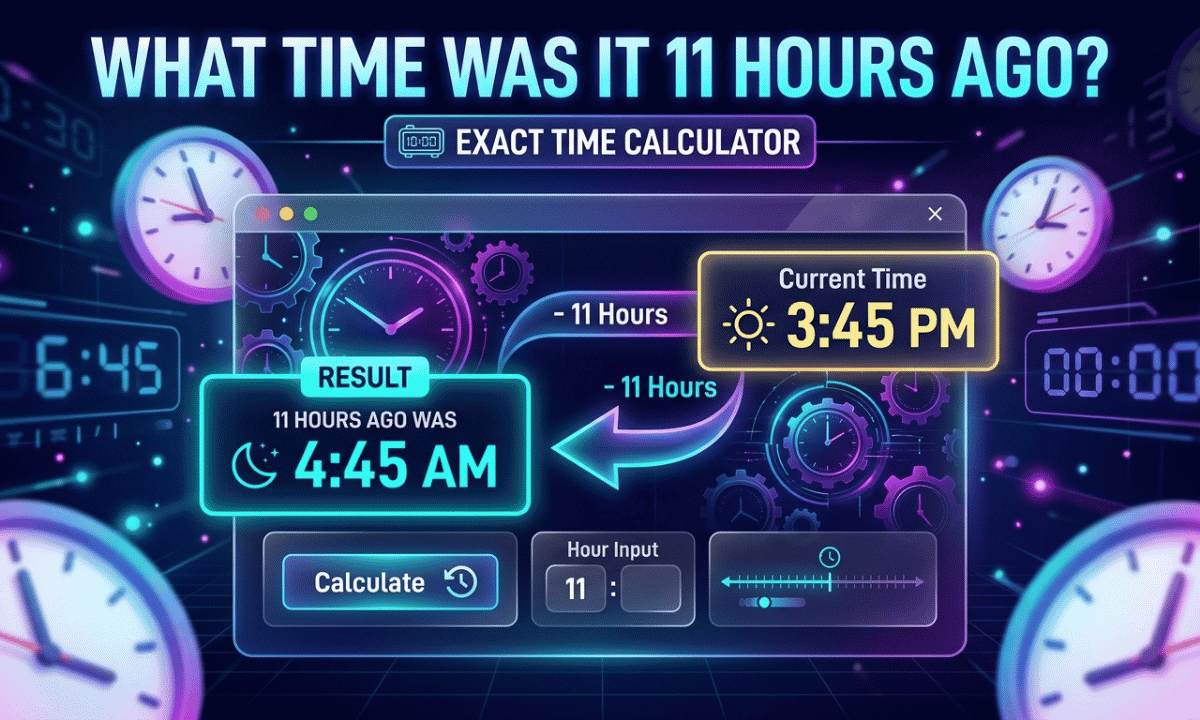
Knowing what time it was 11 hours ago can save you from missed deadlines, confusing logs, and scheduling errors. It sounds easy, yet a quick look at the clock is rarely enough. Dates roll back, time zones shift, and AM and PM trip people up.
This guide shows you how to find the exact time 11 hours ago in a few seconds. You will learn the manual method, the most common mistakes, and the tools that do the math for you. You will also see handy tables and real examples.
Whether you track shifts, check server logs, or plan a call across countries, the answer is only a few steps away.
What Time Was It 11 Hours Ago?
The answer depends on the time right now. Take the current time and subtract eleven hours. That gives you the exact time 11 hours ago.
Here is a quick example. If it is 3:00 PM now, the time was 4:00 AM on the same day. If it is 8:00 AM now, the time was 9:00 PM the previous evening.
Use this table as a fast reference.
| Current Time | Time Eleven Hours Earlier | Date |
| 12:00 AM (midnight) | 1:00 PM | Previous day |
| 2:00 AM | 3:00 PM | Previous day |
| 4:00 AM | 5:00 PM | Previous day |
| 6:00 AM | 7:00 PM | Previous day |
| 8:00 AM | 9:00 PM | Previous day |
| 10:00 AM | 11:00 PM | Previous day |
| 12:00 PM (noon) | 1:00 AM | Same day |
| 2:00 PM | 3:00 AM | Same day |
| 4:00 PM | 5:00 AM | Same day |
| 6:00 PM | 7:00 AM | Same day |
| 8:00 PM | 9:00 AM | Same day |
| 10:00 PM | 11:00 AM | Same day |
Notice the pattern. Before 11:00 AM, the answer lands on the previous day. From 11:00 AM onward, it stays on the same day.
Understanding Time Calculation in Everyday Life
We calculate time all day without noticing. You check how long until lunch. You work out when a package left the warehouse. You count back to see when a message was sent.
Most of these tasks involve elapsed time. Elapsed time is the gap between two moments. Finding the time 11 hours ago simply means measuring that gap backward from now.
Two clock formats make this harder than it looks:
- 12-hour clock: Uses AM and PM. Easy to read, but easy to flip by mistake.
- 24-hour clock: Runs from 00:00 to 23:59. Cleaner for math and common in healthcare, aviation, and logistics.
Both formats work. The key is staying consistent while you calculate. Switching formats halfway is where most errors begin.
Eleven hours is also an awkward number. It is almost half a day, but not quite. That is why many people guess and land one hour off.
How to Calculate What Time Was 11 Hours Ago Manually
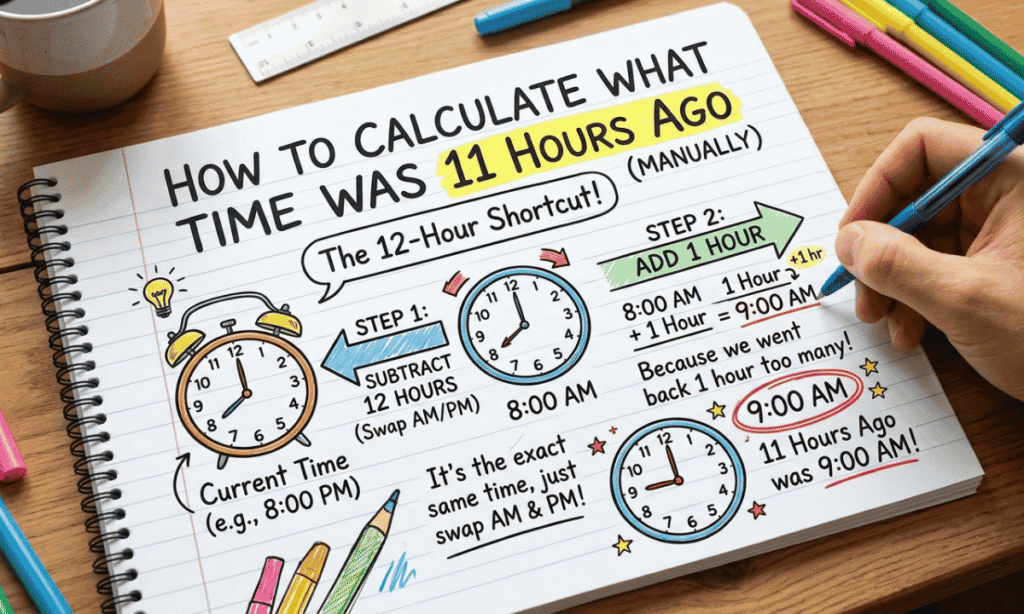
You do not need an app to find the answer. Three small steps are enough. Learn them once and you can find the time 11 hours ago anywhere.
Step 1: Note the Current Time
Start with the exact time right now. Write down the hour, the minutes, and AM or PM. If you use a 24-hour clock, write it as four digits, such as 14:45.
Also note today’s date and day of the week. You will need them in Step 3.
Example: it is 2:45 PM on a Tuesday.
Step 2: Subtract Eleven Hours
Now subtract 11 from the hour. Leave the minutes alone. Minutes do not change when you subtract whole hours.
Use whichever method feels easiest:
- Direct subtraction (12-hour clock): Subtract 11 from the hour. If the result is zero or negative, add 12 and switch AM to PM, or PM to AM.
- The shortcut: Subtract 12 hours, then add 1 hour. Eleven is just one less than twelve.
- 24-hour method: Subtract 11:00. If the answer is negative, add 24:00.
Try it with 2:45 PM. Direct subtraction gives 2 − 11 = −9. Add 12 to get 3, then switch PM to AM. The answer is 3:45 AM.
The shortcut agrees. Subtract 12 hours to get 2:45 AM, then add one hour for 3:45 AM.
Practice on a few numbers and you will trust the method for 11 hours ago every time.
Step 3: Check the Date
This is the step people skip. Ask one question: did I cross midnight?
If the current time is before 11:00 AM, the answer falls on the previous day. If it is 11:00 AM or later, the date stays the same.
Example: it is 9:20 AM on Wednesday. Eleven hours earlier was 10:20 PM on Tuesday.
Why the Date Sometimes Changes
The date changes whenever your calculation crosses midnight. That happens often with an eleven-hour gap. It is nearly half a day, so any morning time rolls back to yesterday.
Here are the situations where the date shifts:
- Midnight crossing: Any time before 11:00 AM moves to the previous day.
- Month boundary: On March 1, a morning calculation lands on February 28 or 29.
- Year boundary: At 6:00 AM on January 1, the earlier time is 7:00 PM on December 31.
- Leap years: February has 29 days in years like 2028, which affects date math near March 1.
- Daylight saving changes: On clock-change days, a day may have 23 or 25 hours.
That last point surprises many people. On the night clocks move forward, an eleven-hour gap on the wall clock may not equal eleven real hours. Always check for local clock changes when the date is close to one.
What Time Was It 11 Hours Ago Across Different Time Zones
Time zones add another layer. The same moment shows a different clock time in every region. The safest approach is to convert everything to UTC first.
Here is a simple example. Suppose it is 12:00 UTC right now. Eleven hours earlier was 01:00 UTC. Then add each region’s offset.
| Time Zone | UTC Offset | Local Time 11 Hours Earlier |
| UTC / GMT | +0:00 | 1:00 AM |
| UAE (Gulf Standard Time) | +4:00 | 5:00 AM |
| India Standard Time | +5:30 | 6:30 AM |
| China / Singapore | +8:00 | 9:00 AM |
| Japan Standard Time | +9:00 | 10:00 AM |
| US Eastern (standard time) | −5:00 | 8:00 PM (previous day) |
| US Pacific (standard time) | −8:00 | 5:00 PM (previous day) |
Offsets change when daylight saving time is active. For example, US Eastern is UTC−4 in summer. Always confirm the current offset before relying on a table.
Half-hour zones, like India’s, need extra care. Add the 30 minutes after you finish the hour math.
When you need the time 11 hours ago in another city, follow this order:
- Convert the current local time to UTC.
- Subtract eleven hours.
- Convert the result to the target time zone.
- Check the date again.
Using a Time Calculator
A time calculator removes the guesswork. You enter the starting time, choose “subtract,” and set the amount to eleven hours. The tool returns the exact answer, including the date.
Good tools share a few features:
- Support for both 12-hour and 24-hour formats
- Automatic date rollback across months and years
- Time zone conversion
- Daylight saving awareness
- A “use current time” button
A spreadsheet works too. In Excel or Google Sheets, type =NOW()-TIME(11,0,0) into a cell. The cell shows the time 11 hours ago, updated whenever the sheet recalculates. Format the cell as date and time to see the full result.
Calculators are fast, but they are not magic. They rely on your device clock and settings. If your phone has the wrong time zone, the answer will be wrong too.
Converting Eleven Hours Into Different Units
Sometimes you need the gap in minutes or seconds. Logs, timers, and software often use smaller units. The conversions are simple.
| Unit | Value for 11 Hours |
| Minutes | 660 |
| Seconds | 39,600 |
| Milliseconds | 39,600,000 |
| Days | 0.4583 (11 ÷ 24) |
| Weeks | About 0.0655 |
Knowing that 11 hours ago equals 660 minutes ago helps when a system reports age in minutes. Multiply hours by 60 for minutes, and by 3,600 for seconds.
To convert eleven hours into days, divide by 24. The result is a little under half a day. That matches what we saw earlier: the time lands on the previous day for most morning moments.
Why Computers Handle Time Better Than Humans
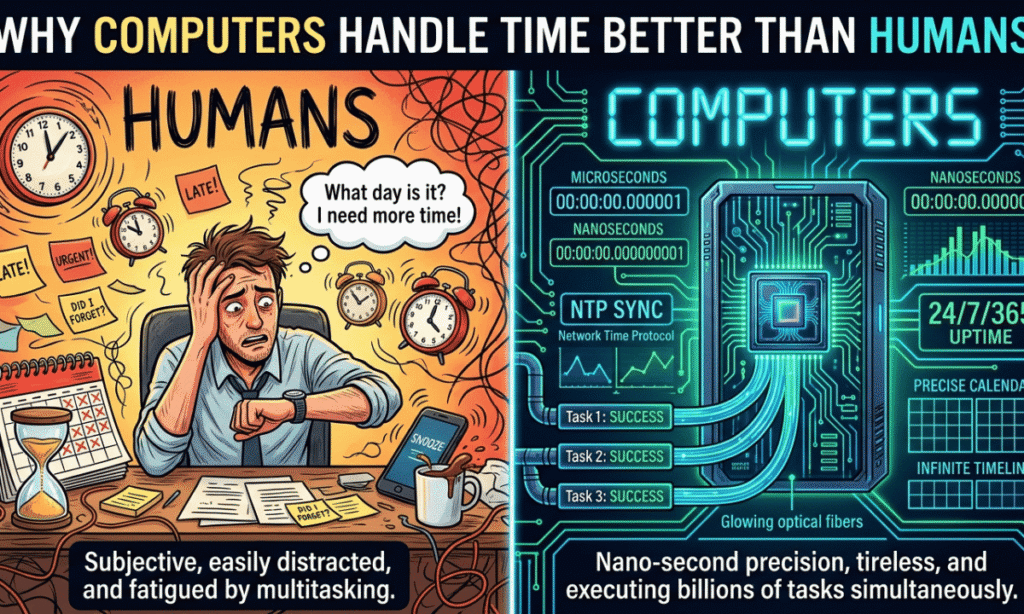
People think in clocks and calendars. Computers think in numbers. That difference makes machines far more reliable for time math.
Most systems store time as a count of seconds since a fixed starting point. Unix systems, for example, count from January 1, 1970, in UTC. That count is called a timestamp.
To find the time 11 hours ago, a computer subtracts 39,600 seconds from the timestamp. No AM or PM. No midnight confusion. No month lengths to remember.
Computers also use the IANA time zone database. It tracks offsets and daylight saving rules for regions worldwide. When you ask for a local time, the system applies the correct rule for that date.
Humans make small errors under pressure. We forget to flip AM and PM. We forget the date. A machine does the same steps correctly every time, which is why a time calculator is worth using for anything important.
What Time Was It 11 Hours Ago Versus Hours From Now
Looking backward and looking forward use the same math with opposite directions. Mixing them up is a classic slip. Let’s compare both.
Looking Back
“11 hours ago” means a moment in the past. You subtract eleven hours from the current time. If it is 4:30 PM, the answer is 5:30 AM the same day.
This is the direction used for logs, timestamps, and “posted earlier” labels.
Looking Forward
“11 hours from now” means a moment in the future. You add eleven hours. If it is 4:30 PM, the answer is 3:30 AM the next day.
This is the direction used for deadlines, flights, and scheduled events.
| Current Time | 11 Hours Ago | 11 Hours From Now |
| 6:00 AM | 7:00 PM (previous day) | 5:00 PM (same day) |
| 12:00 PM | 1:00 AM (same day) | 11:00 PM (same day) |
| 4:30 PM | 5:30 AM (same day) | 3:30 AM (next day) |
| 9:00 PM | 10:00 AM (same day) | 8:00 AM (next day) |
Here is a neat trick. On a 12-hour clock face, eleven hours back shows the same time as thirteen hours ahead. The two differ by exactly 24 hours.
Common Mistakes When Calculating Eleven Hours Ago
Even simple math goes wrong when you rush. These are the errors that show up most often when people work out 11 hours ago:
- Forgetting to flip AM and PM. Crossing noon or midnight changes the label.
- Ignoring the date. The time is right, but the day is wrong.
- Subtracting 10 or 12 by accident. Eleven is easy to misjudge by one.
- Mixing 12-hour and 24-hour formats. Pick one and stay with it.
- Skipping time zones. Two people in different regions get different answers.
- Overlooking daylight saving time. Clock changes can add or remove an hour.
- Touching the minutes. Whole-hour subtraction should never change them.
A quick sanity check helps. Add eleven hours to your answer. If you land back on the starting time, your result is correct.
Everyday Situations Where This Calculation Matters
You might think this is a niche skill. It is not. Many ordinary tasks depend on knowing the exact time 11 hours ago.
- Shift work: Nurses, drivers, and factory staff track hours since a shift began.
- Medication schedules: Caregivers confirm when the last dose was given.
- Travel planning: Travelers work out what time it was at home when they landed.
- IT and server logs: Engineers search for events from the past eleven hours.
- Customer support: Agents check when a ticket or order status last changed.
- Social media: A post marked “11 hours ago” needs a real clock time for reporting.
- Sleep and fitness tracking: Users compare activity to the same point earlier.
- Shipping and delivery: Teams trace when a parcel left a facility.
In each case, a small mistake has a real cost. A wrong dose time or a missed log window can cause real problems.
Similar Time Calculators You Might Need
If you landed here, you may need a related calculation. Most of these use the same method with a different number.
| Calculation | Typical Use |
| 1 to 6 hours ago | Short-term logs and recent activity |
| 8 hours ago | A standard workday or sleep cycle |
| 10 hours ago | Overnight events and long shifts |
| 12 hours ago | Half-day checks, AM and PM flips |
| 24 hours ago | Daily reports and same-time-yesterday checks |
| Hours from now | Deadlines, reminders, and scheduling |
| Minutes ago | Quick timers and fast-moving updates |
| Days ago | Project timelines and delivery tracking |
If 11 hours ago is not quite what you need, change the number and repeat the steps. The logic never changes. Only the amount you subtract does.
Read More What Time Was It 9 Hours Ago
Time Calculation Tips for Better Accuracy
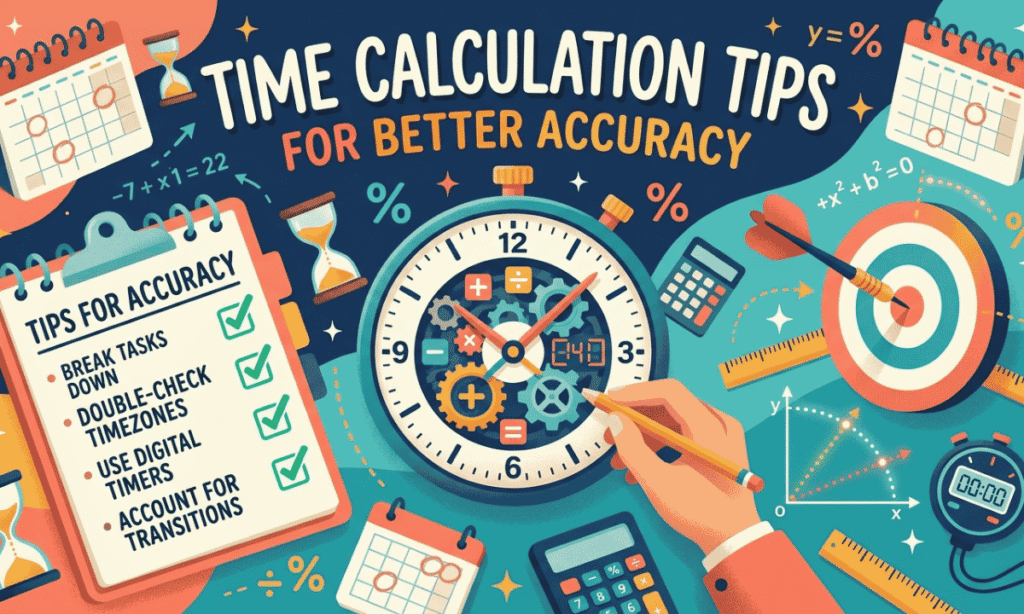
A few habits make every calculation safer. Use these whenever precision matters:
- Write down the starting time and date before you begin.
- Use the 24-hour clock for cleaner math.
- Convert to UTC when two time zones are involved.
- Use the shortcut: subtract 12, then add 1.
- Check whether the result crosses midnight.
- Verify daylight saving rules for the date in question.
- Double-check by adding eleven hours back to your answer.
- Use a trusted calculator for high-stakes tasks.
Consistency matters more than speed. Slow down for the date check, because that is the step most people miss.
Related Concepts Worth Knowing
A few terms come up often in time math. Understanding them makes every calculation easier.
- UTC (Coordinated Universal Time): The global standard that all time zones are measured against.
- GMT (Greenwich Mean Time): A time zone that matches UTC in winter for the UK.
- Time zone offset: The number of hours a region is ahead of or behind UTC.
- Daylight saving time (DST): A seasonal clock change used in many countries.
- Unix timestamp: A count of seconds since January 1, 1970, used by computers.
- ISO 8601: An international format for writing dates and times, like 2026-10-19T14:45:00Z.
- Time delta: The difference between two points in time.
- Elapsed time: How much time has passed between a start and an end.
Conclusion
Finding 11 hours ago comes down to three habits. Note the current time, subtract eleven hours, and check the date. Add a time zone check when more than one region is involved.
The shortcut of subtracting twelve and adding one makes mental math quick. Tables and calculators make it even safer.
Keep the common mistakes in mind, especially AM and PM flips and date rollbacks. With a little practice, you will get the right answer every time.
Frequently Asked Questions
What time was it 11 hours ago from now?
Subtract eleven hours from your current local time. For example, if it is 5:00 PM now, it was 6:00 AM today.
How do I calculate 11 hours ago without a calculator?
Subtract 12 hours from the current time, then add one hour. Then check whether you crossed midnight.
Does 11 hours ago change the date?
Yes, if the current time is before 11:00 AM. In that case the answer falls on the previous day.
How many minutes are in 11 hours?
There are 660 minutes in 11 hours. Multiply 11 by 60 to get the number.
How many seconds are in 11 hours?
There are 39,600 seconds in 11 hours. Multiply 11 by 3,600.
What is the easiest shortcut for finding 11 hours ago?
Take away 12 hours and add 1 hour. It works on both 12-hour and 24-hour clocks.
Is 11 hours ago the same in every time zone?
No. The moment is the same, but the clock time differs by region. Convert to UTC first, then apply each local offset.
Does daylight saving time affect 11 hours ago?
It can. On clock-change days, a wall-clock gap may differ from real elapsed time by one hour.