

How long until 2:30 PM? The answer changes every minute, so a quick method really helps. Whether you are watching the clock for a meeting, a flight, or a school pickup, this guide has you covered.
Here you will find easy math, handy tools, and smart planning tips. You will also learn how time zones and daylight saving time can shift the answer. Each section is short, so you can skim and find what you need.
Let’s start with the basics.
Understanding How Long Until 2:30 PM
Counting down to a time is just subtraction. You need two things: the current time and the target time.
The target here is 2:30 PM. In the 24-hour system, that is 14:30. It also sits 870 minutes after midnight.
The gap between now and then is your countdown. It has an hour part and a minute part.
Here is a quick example. Say it is 11:12 AM. The next full hour is 12:00 PM, which is 48 minutes away. From noon, the target is 2 hours and 30 minutes away. Add them up and you get 3 hours and 18 minutes.
People check this for many reasons. Common ones include:
- Meetings and video calls
- Doctor, dentist, or salon appointments
- School pickups and exam start times
- Train, bus, and flight departures
- Delivery cut-offs and work deadlines
- Lunch breaks and shift changes
A fixed target is easy to plan around. The tricky part is that your starting point keeps moving.
How Long Until 2:30 PM Changes Every Second
The countdown never pauses. One minute from now, the answer will be one minute shorter.
That is why a written answer is never enough. A live countdown timer updates every second. It shows the hours, minutes, and seconds left.
The table below shows how the time remaining shrinks through the day.
| Current time | Time left |
| 7:00 AM | 7 hours 30 minutes |
| 9:00 AM | 5 hours 30 minutes |
| 11:00 AM | 3 hours 30 minutes |
| 12:00 PM | 2 hours 30 minutes |
| 1:00 PM | 1 hour 30 minutes |
| 2:00 PM | 30 minutes |
| 2:25 PM | 5 minutes |
Notice the pattern. Each passing hour removes 60 minutes from the countdown.
Seconds matter too. At 2:29 PM, only 60 seconds remain. A live timer shows this. A written answer cannot.
Think of 2:30 PM as a fixed point on the clock. Only your position moves toward it.
Ways to Calculate the Time Until 2:30 PM
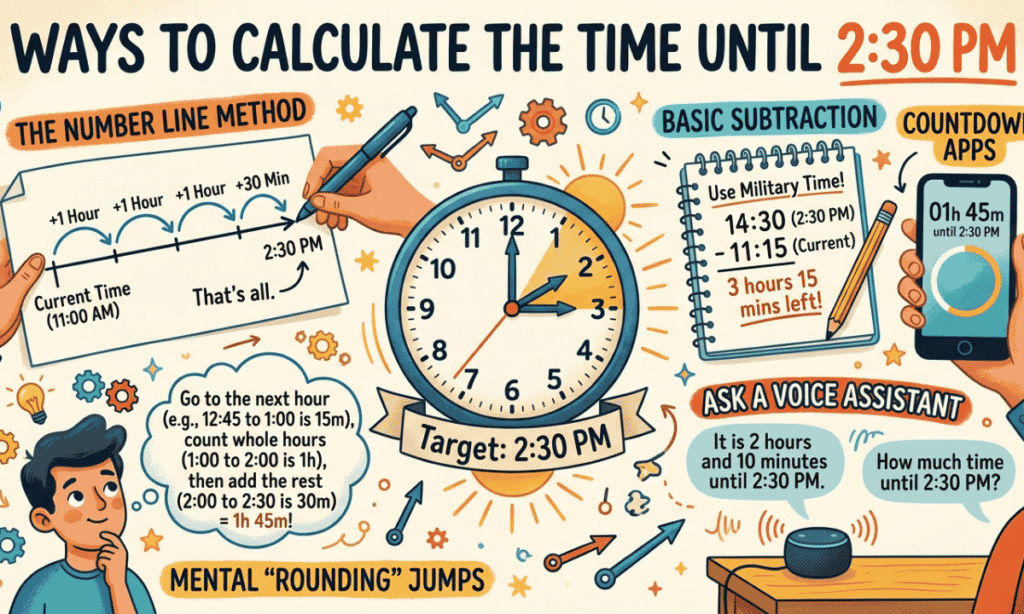
You have three practical options. You can do the math by hand, use a countdown calculator, or use a duration calculator.
Each one fits a different situation. Let’s look at them in turn.
Manual calculation
Manual math is fast once you know the trick. Split the gap into two parts. Count to the next full hour first. Then add what remains.
Follow these steps:
- Note the current time.
- Count the minutes to the next full hour.
- Count the full hours until 2:00 PM.
- Add the final 30 minutes.
Try it with 9:40 AM:
- 9:40 AM to 10:00 AM is 20 minutes.
- 10:00 AM to 2:00 PM is 4 hours.
- Add the last 30 minutes.
The total is 4 hours and 50 minutes.
You can also use the 24-hour clock. Convert the current time, then subtract it from 14:30. If the minutes go below zero, borrow one hour and add 60 minutes.
For example, at 13:50, you have 40 minutes left.
What if the time has already passed? Say it is 3:15 PM. Then 2:30 PM ended 45 minutes ago. The next one is 23 hours and 15 minutes away.
One more tip: set a pre-alarm 15 minutes early. It gives you a buffer to wrap up.
Using a Countdown Calculator
A countdown calculator does the math for you. You enter the target time. The tool shows what is left, usually in real time.
Many websites offer a ready-made page for this exact search. Some add alarms, full-screen mode, and a sound when the timer hits zero.
Main benefits:
- No mental math needed
- Live updates by the second
- Alerts when the timer ends
- Works for any time, not only 2:30 PM
These tools are best when you need precision. They also suit people who check the clock often.
One small warning. Make sure the tool uses your device’s local time. A wrong setting gives a wrong answer.
Using a Duration Calculator
A duration calculator finds the gap between two times. You enter a start time and an end time. The tool returns the difference.
For this topic, set the end time to 2:30 PM. Then pick any start time you like. The result is the exact duration.
This is handy for planning ahead. Say you start work at 10:15 AM. You have 4 hours and 15 minutes before the target.
Duration calculators also handle date ranges. That helps with overnight shifts or events that cross midnight.
Here is how the three methods compare:
| Method | Speed | Best for | Live updates |
| Manual calculation | Medium | Quick mental checks | No |
| Countdown calculator | Fast | Live tracking | Yes |
| Duration calculator | Fast | Planning between two times | No |
Understanding 2:30 PM in Different Time Formats
Time is written in several ways. Knowing them avoids mix-ups.
| Format | Written as |
| 12-hour clock | 2:30 PM |
| 24-hour clock | 14:30 |
| Military time | 1430 hours |
| Spoken military time | Fourteen thirty |
| Minutes after midnight | 870 |
| Seconds after midnight | 52,200 |
The 12-hour clock uses AM and PM. The 24-hour clock does not. That removes confusion.
To convert, add 12 to the hour. The minutes stay the same. So 2 PM becomes 14, and the half hour stays 30.
Be careful with AM and PM. 2:30 AM is a very different time. It falls in the middle of the night.
How long until 2: 30 pm countdown
This search is very common. People often skip the colon when typing fast. The meaning stays the same.
A countdown shows three numbers: hours, minutes, and seconds. Some also show days when the target is tomorrow.
Here is how to read one:
- Hours: full hours left
- Minutes: minutes after those hours
- Seconds: the live ticking part
Say the display reads 01:12:45. That means 1 hour, 12 minutes, and 45 seconds remain.
When it reads 00:00:00, the moment has arrived.
Many countdowns reset after zero. They then count toward the same time the next day. Check the settings if you want a one-time timer.
How many hours until 2pm today
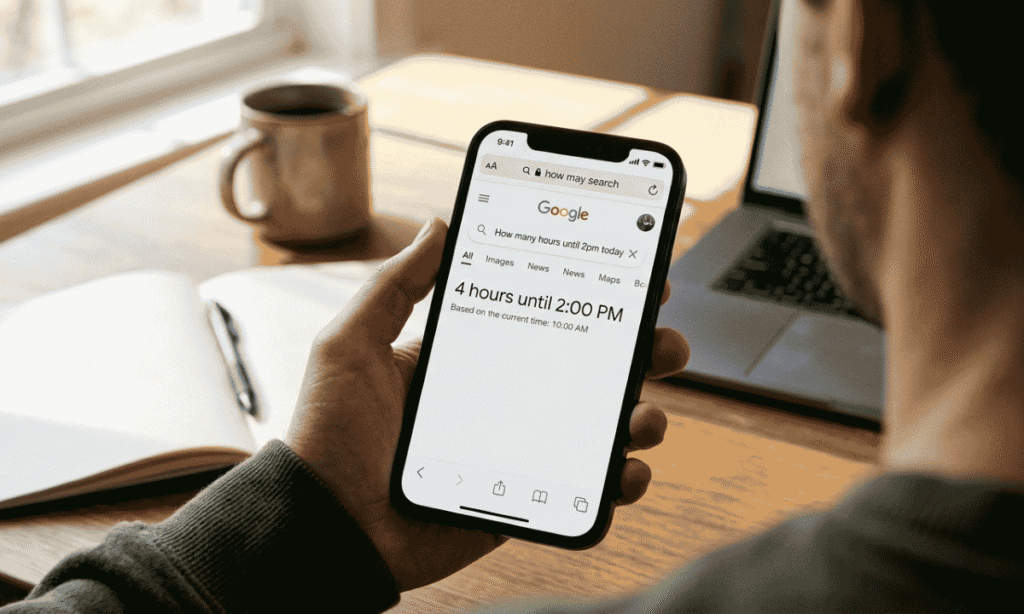
Some people ask about 2 PM instead. The gap to 2 PM is always 30 minutes shorter than the gap to 2:30 PM.
So count the hours to 2 PM first. Then add half an hour for the later target.
The word “today” matters here. After 2 PM, the answer points to tomorrow.
| Current time | Until 2 PM | With the extra half hour |
| 8:00 AM | 6 hours | 6 hours 30 minutes |
| 10:00 AM | 4 hours | 4 hours 30 minutes |
| 12:00 PM | 2 hours | 2 hours 30 minutes |
| 1:30 PM | 30 minutes | 1 hour |
When is 2 30 PM
When is 2 30 PM? It falls in the early afternoon, two and a half hours after noon.
It is also exactly 9 hours and 30 minutes before midnight.
For many people, it comes right after lunch. Schools often wrap up around this time. Offices see a dip in energy as well. Many call it the afternoon slump.
That makes it a popular slot for meetings and appointments. It avoids the lunch rush and still leaves time to finish the day.
How long until 2:30 PM est
EST stands for Eastern Standard Time. It is UTC minus 5 hours. In summer, the region switches to EDT, which is UTC minus 4 hours.
So 2:30 PM EST equals 19:30 UTC. People often write “EST” all year, even in summer. Always check which one is meant.
To find the time left, follow three steps:
- Check your local time.
- Convert it to Eastern Time.
- Subtract it from 14:30.
Here are some quick conversions. They assume the US is on standard time and the UK is on GMT.
| Location | Local time when it is 2:30 PM EST |
| Los Angeles (PST) | 11:30 AM |
| Chicago (CST) | 1:30 PM |
| London (GMT) | 7:30 PM |
| Dubai (GST) | 11:30 PM |
| Karachi (PKT) | 12:30 AM (next day) |
| Mumbai (IST) | 1:00 AM (next day) |
| Tokyo (JST) | 4:30 AM (next day) |
Here is an example. It is 8:00 PM in Karachi. That equals 10:00 AM in New York on standard time. The gap to the target is 4 hours and 30 minutes.
Comparing 2:30 PM with Nearby Times
Plans shift all the time. A meeting may move by 15 minutes. Seeing nearby times side by side helps you adjust fast.
| Time | 24-hour | Minutes after midnight | Difference |
| 2:00 PM | 14:00 | 840 | 30 minutes earlier |
| 2:15 PM | 14:15 | 855 | 15 minutes earlier |
| 2:30 PM | 14:30 | 870 | Target time |
| 2:45 PM | 14:45 | 885 | 15 minutes later |
| 3:00 PM | 15:00 | 900 | 30 minutes later |
Each step is 15 minutes. That equals 15 on the minutes-after-midnight scale.
You can use this table for quick shifts. If the target moves from 2:15 PM to 2:45 PM, add 30 minutes to your countdown.
Using a Live Countdown for Better Planning

A live countdown turns a vague idea into a clear number. “Soon” becomes “47 minutes.”
That clarity helps you plan. You know if there is time for a call, a snack, or a final edit.
Here is how to get the most from one:
- Keep the timer visible on a second screen or tab.
- Turn on sound or push alerts.
- Set a reminder 15 minutes early.
- Use full-screen mode for group events.
Teachers use countdowns for class activities. Event hosts use them for launches. Remote teams use them to start calls on time.
Seeing the seconds tick also builds a healthy sense of urgency. You stop drifting and start finishing.
Time Zones Matter More Than People Think
A countdown only works if both sides use the same time zone. Mixing them up is one of the most common scheduling errors.
A call set for 2:30 PM in New York is 11:30 AM in Los Angeles. It is 7:30 PM in London. Each person has a very different countdown.
Follow these habits to stay safe:
- Always write the time zone next to the time.
- Use UTC for global teams.
- Use a time zone converter before sending invites.
- Confirm the local time on your device.
Calendar apps help by converting times automatically. Still, double-check big events. One wrong zone can cost a whole meeting.
Daylight Saving Time Can Change Everything
Daylight saving time moves clocks forward or back by one hour. That shift can break a countdown.
A countdown to 2:30 PM can be an hour off if the clock change happens in between. The math you did before bed may be wrong by morning.
In the US, clocks move forward in March. They fall back on the first Sunday of November. Many other countries use different dates, and some skip the change entirely.
Keep these points in mind:
- Check whether your location observes daylight saving time.
- Confirm if the other location does too.
- Expect gaps between zones to change for a few weeks.
- Use a tool that updates automatically.
Smartphones usually handle the change on their own. Manual math does not. When a clock change is close, trust a live tool.
Popular Tools That Help Track the Countdown
You do not need fancy software. Many free options work well.
| Tool type | Examples | Best use |
| Search engine | Google time queries | Fast, one-off answers |
| Countdown websites | Days.to, Inch Calculator countdown timer | Live hours, minutes, seconds |
| World clock sites | Time and Date | Time zone and DST checks |
| Phone clock apps | iOS Clock, Android Clock | Alarms and timers |
| Voice assistants | Siri, Google Assistant, Alexa | Hands-free reminders |
Countdown websites are great for live tracking. Some even send a notification when time is up.
Phone apps are best for daily life. They work offline and run in the background.
World clock sites shine for global teams. They show the same moment in many cities.
Productivity Benefits of Knowing the Exact Countdown
Knowing how long until 2:30 PM lets you split work into clear blocks. You stop guessing and start planning.
Here are the main benefits:
- Better focus: a visible deadline reduces distractions.
- Less stress: you know exactly what is left.
- Smarter task order: you pick jobs that fit the gap.
- Fewer late starts: you leave on time.
Try the time-block method. If you have 45 minutes left, choose one task and finish it. Skip anything that needs more time.
Add a buffer too. If you need to finish by the target time, plan to be done 10 minutes early. Small delays happen to everyone.
Short sprints work well here. A 25-minute focus session fits neatly into many countdown windows.
Morning vs Afternoon Countdowns
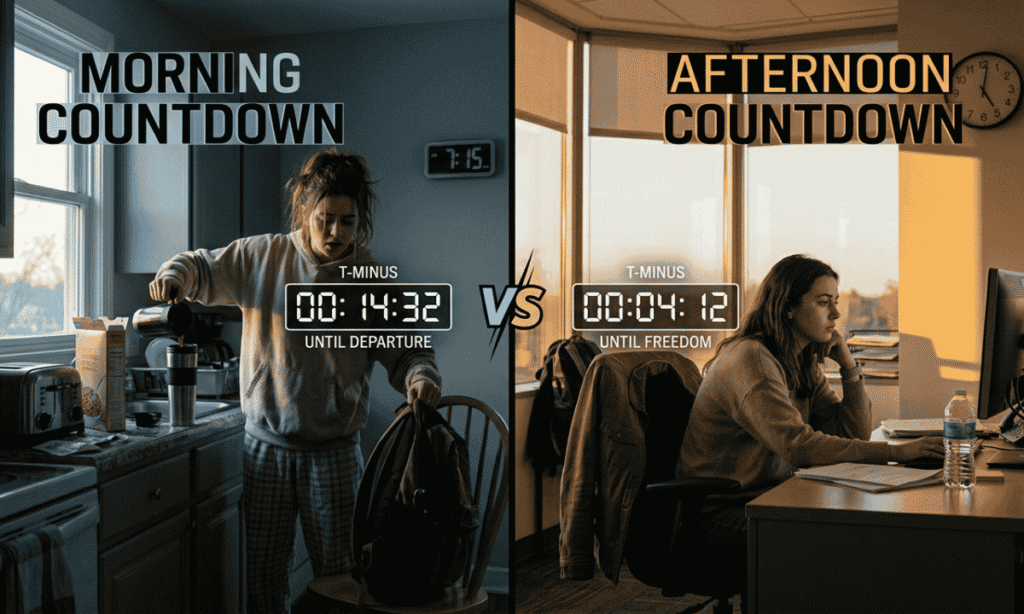
Time feels different at different hours. That affects how you use a countdown.
A countdown to 2:30 PM from the morning is long. You have room for deep work. Your energy is often higher before lunch.
From the early afternoon, the same countdown is short. Energy dips, and tasks take longer.
| Factor | Morning countdown | Afternoon countdown |
| Time left | Several hours | Under two hours |
| Energy level | Usually higher | Often lower |
| Best tasks | Hard or creative work | Light or routine work |
| Main risk | Delaying the start | Running out of time |
Plan around this pattern. Do the hardest work early. Save emails and admin for later.
Also, add extra buffer after lunch. Most people move a bit slower then.
Choosing the Right Countdown Tool
The best tool depends on your goal. Ask yourself a few simple questions.
- Do I need live seconds or just a rough idea?
- Will I work across time zones?
- Do I need an alarm or alert?
- Will I use it once or every day?
Here is a simple guide:
- One quick check: use a search engine or mental math.
- Live tracking: use a countdown website.
- Daily routines: use a phone alarm or timer.
Global teams: use a world clock and time zone converter.
Pick one tool and stick with it. Too many tools create confusion. A simple setup that you actually use beats a perfect one you ignore.
Conclusion
Finding out how long until 2:30 PM is easy once you know the steps. Subtract the current time from 14:30, or let a live countdown do the work.
Remember the key points. Time zones change the answer. Daylight saving time can shift it by an hour. And a simple pre alarm gives you a helpful buffer.
Pick the method that fits your day. Use mental math for quick checks, and a countdown timer when seconds count. Plan ahead, stay on schedule, and let the clock work for you.
Frequently Asked Questions
How long until 2:30 PM from now?
Subtract your current time from 14:30. For exact seconds, use a live countdown timer.
What is 2:30 PM in 24-hour time?
It is 14:30, or 1430 in military time.
How many hours until 2 PM today?
Subtract the current time from 14:00. After 2 PM, the answer points to tomorrow.
How many minutes are there from noon to the target time?
There are 150 minutes. That equals 2 hours and 30 minutes.
How do I convert Eastern time to my local time?
Find the UTC offset for both places. Add or subtract the difference, or use a time zone converter.
Does daylight saving time change the countdown?
Yes. A clock change can add or remove an hour, so use a tool that updates automatically.
What is the easiest way to track the countdown?
A countdown website or a phone timer is simplest. Both update on their own and can alert you.
What if the time has already passed today?
The next one is tomorrow. At 3:15 PM, for example, you wait 23 hours and 15 minutes.